#AI编程
9437 related articles

AI SDK Topaz 3.0.15 Released: Documentation Improvements and Dependency Updates
AI SDK Topaz 3.0.15 patch released, unifying README documentation format and synchronizing @ai-sdk/provider and provider-utils dependencies for better compatibility and developer experience.

@ai-sdk/tui 1.0.154 Release Update Analysis
@ai-sdk/tui 1.0.154 patch update: README formatting unified and ai dependency upgraded to 7.0.153 for AI SDK ecosystem compatibility.

typesafe-ai 3.0.27 Released: Documentation Format Unification and Dependency Updates
@ai-sdk/typesafe-ai releases patch version 3.0.27, unifying README format and removing duplicates, while syncing @ai-sdk/provider 4.0.34 and provider-utils 5.0.68.

@ai-sdk/valibot 3.0.68 Patch Release: Documentation Deduplication and Dependency Sync
@ai-sdk/valibot 3.0.68 patch release updates README formatting and deduplication, and syncs dependency @ai-sdk/provider-utils to 5.0.68. Analysis, maintenance significance, and upgrade advice.
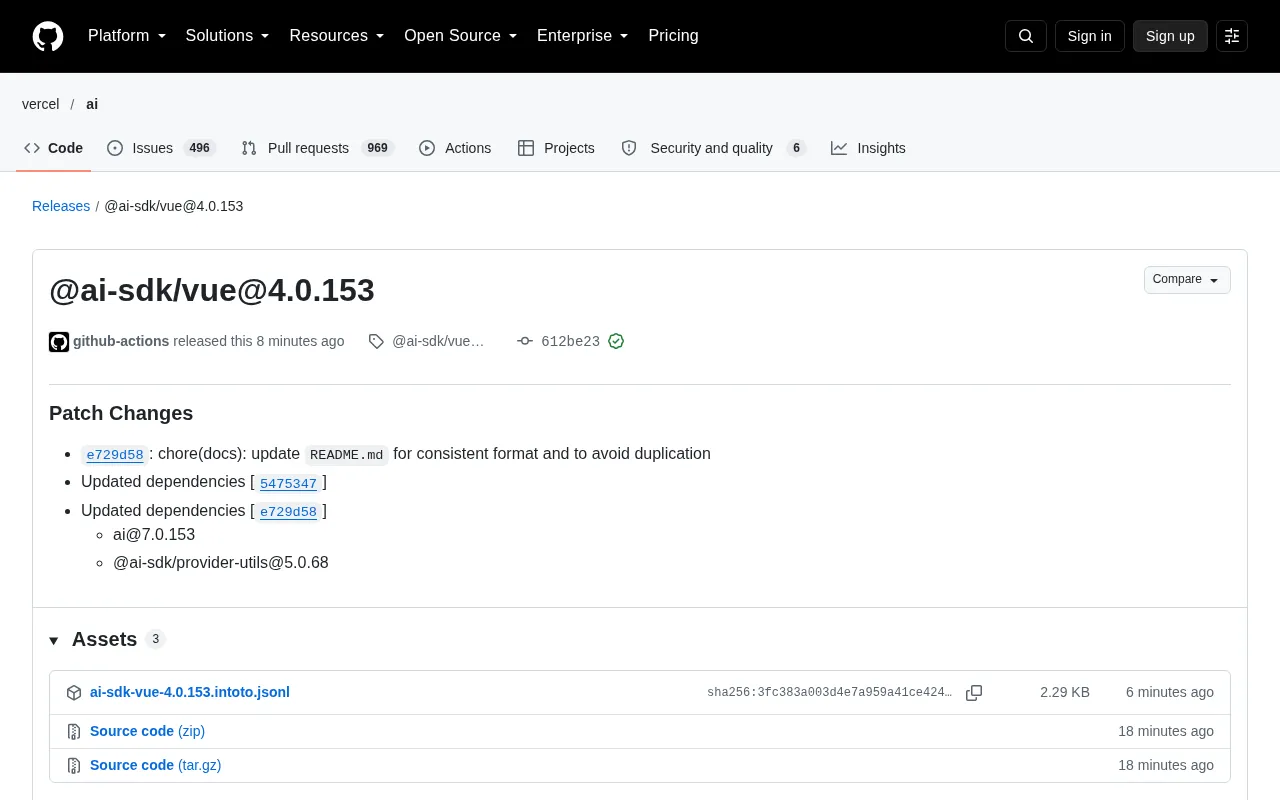
@ai-sdk/vue 4.0.153 Patch Release: Documentation and Dependency Sync Updates
@ai-sdk/vue 4.0.153 patch released: README formatting updated, ai 7.0.153 and @ai-sdk/provider-utils 5.0.68 synced. A look at version dependency coordination and upgrade strategy.

AI SDK Workflow 2.0.85 Patch Release: Documentation Cleanup and Dependency Sync
AI SDK Workflow 2.0.85 patch released, mainly updating README formatting and syncing three underlying dependencies: @ai-sdk/provider, ai, and @ai-sdk/provider-utils. This article analyzes its versioning strategy and practical impact.

@ai-sdk/workflow-harness 1.0.164 Released: Documentation Updates and Dependency Sync
@ai-sdk/workflow-harness releases patch version 1.0.164, updating README documentation formatting and syncing dependency @ai-sdk/harness to improve maintainability and compatibility.

@ai-sdk/xai 5.0.30 Patch Release: What Syncing the Dependency Chain Means
@ai-sdk/xai 5.0.30 patch release updates the README and synchronizes @ai-sdk/provider 4.0.34 and provider-utils 5.0.68. Analysis of dependency alignment for multi-provider projects and upgrade advice.

@ai-sdk/zai 3.0.40 Released: Patch Update and Dependency Sync
@ai-sdk/zai 3.0.40 patch release updates README documentation and syncs three underlying dependencies: @ai-sdk/provider, openai-compatible, and provider-utils. A low-risk maintenance update.
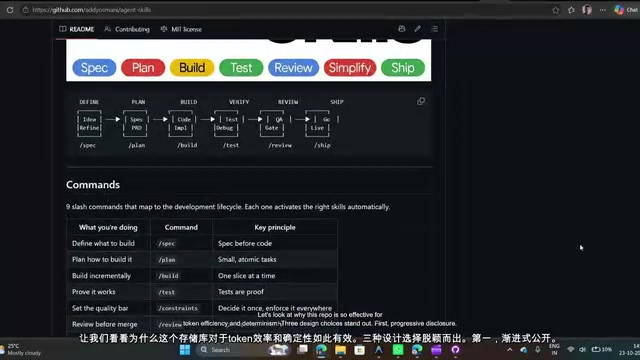
Stop Stuffing 20,000 Lines into CLAUDE.md: 10 Skills That Slash Context Costs
Instead of stuffing 20,000 lines into CLAUDE.md, use a progressively disclosed skill system. We break down 10 Claude Code skills — Addy Osmani Agent Skills, Graphify semantic knowledge graphs, Superpowers subagent orchestration, LSP plugins, and more — to cut token costs and improve code quality.

The Hardest Part of AI Coding Agents Isn't Writing Code—It's Knowing When to Act
A developer shares lessons from building an AI coding agent: the hardest part isn't making the model smarter but teaching it when to act, ask, or stay hands-off.

Agent Skills Progressive Disclosure Architecture Explained: Giving AI Agents Unlimited Capabilities
A detailed explanation of the Agent Skills progressive disclosure architecture: what Agent Skills are, what problems they solve, how to define Skills lists and invocation tools, and how they differ from Multi-Agent.

Ten Must-Know Agent Loop Interview Questions: Breaking Down Bilibili's Most Detailed Loop Engineering Tutorial
Breakdown of Bilibili's Agent Loop interview tutorial: the four dimensions—lifecycle, tools, memory, deliverables—that distinguish Agent Loop from a single API call, plus interview answer templates.

Big Tech AI Engineering Interview: Full-Chain Observability from Frontend Monitoring to Agents
From PerformanceObserver metrics collection and onerror/unhandledrejection exception capture, to RAG pipeline reranking and context compression for token cost control, to designing a full-site AI full-chain observability system benchmarked against LangSmith and Sentry—breaking down the three progressive layers of big tech AI engineering interviews.
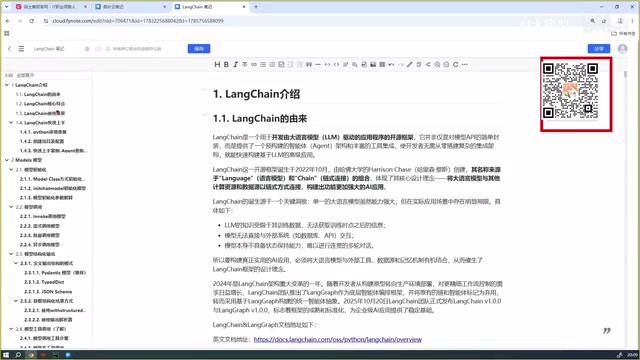
Bilibili DeepAgents Practical Tutorial: From LangChain Basics to Agent Development
Bilibili DeepAgents tutorial practical analysis: from LangChain framework basics to agent development, covering the core path of building large model applications, including code implementation and learning advice, suitable for AI application development beginners.

LLM WIKI Architecture Explained: Making Agents Truly Understand Enterprise Business
A breakdown of Bilibili creator Lao Xiao's hands-on AI knowledge base tutorial: how the LLM WIKI architecture solves the problem of agents not understanding enterprise business, from the difficulty of textualizing business knowledge to a real-world order customer service case.

TIA Portal and Factory IO in Practice: Stacker Crane PLC Address Symbol Table Configuration Tutorial
This article details how to configure the stacker crane PLC address symbol table in joint debugging between TIA Portal and Factory IO, covering project template usage, input/output variable addition, system clock settings, and simulation connection tips for automation engineers.

Fine-Tuning Large Models Without Changing Weights: PEFT, Adapters, and Prefix Tuning Explained
Explaining the three main PEFT routes: LoRA, adapters, and prefix tuning. How to fine-tune large models without updating original weights, the pros and cons of each method, selection advice, and tuning and deployment considerations in practice.

Battledrones v14 Review: Claude Opus 4.5 Builds a Four-Player Map from a Single Prompt
Battledrones v14 releases the Compass Rose four-player map; Simon Willison used one prompt to have Claude Opus 4.5 build a four-way symmetric map and WebSocket four-player support, adding purple and green robot factions.
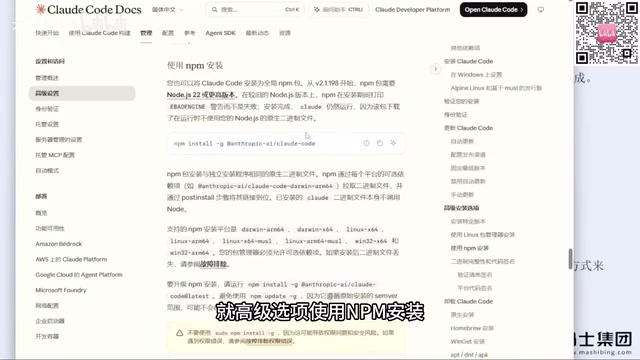
Claude Code Step-by-Step Practical Tutorial: From Installation to Permission Modes, Avoiding Account Bans
Claude Code beginner practical tutorial: detailed npm installation steps, using CC Switch to bypass official login and avoid bans, API Key configuration, and the efficiency difference between permission modes and natural language prompts, helping zero-foundation developers get started quickly.