Deep Dives
In-depth AI analysis, industry observations, and technical insights — slow down and read.

OpDis-PS: Diffusion Posterior Sampling Solves the ECGI Operator Discrepancy Challenge
OpDis-PS is a diffusion posterior sampler that models signal-dependent operator discrepancy to improve ECGI reconstruction accuracy, outperforming classical regularization and learned predictors under lung conductivity changes and subcutaneous fat layer discrepancy, especially on pathological data.

New Breakthrough in Multi-Agent System Security: SecMAS Defends Against Response Manipulation Attacks
The paper proposes the Response Manipulation Attack ReMA, which iteratively optimizes malicious responses to manipulate multi-agent system decisions, and designs the SecMAS secure aggregation rule that uses semantic similarity to select consistent responses, providing theoretical security guarantees and experimentally proving effective defense against various attacks while maintaining comparable utility.

G-CAST: Enabling E-commerce Agents to Keep Evolving Amid Demand Drift
G-CAST is a governed continual self-training system from Alibaba's 1688 team that uses reward routing, entropy-based data orchestration, governed reward evolution, and checkpoint switching to keep e-commerce Agents evolving amid demand drift and toolchain evolution. It has been deployed in the YuanCai B2B procurement Agent.
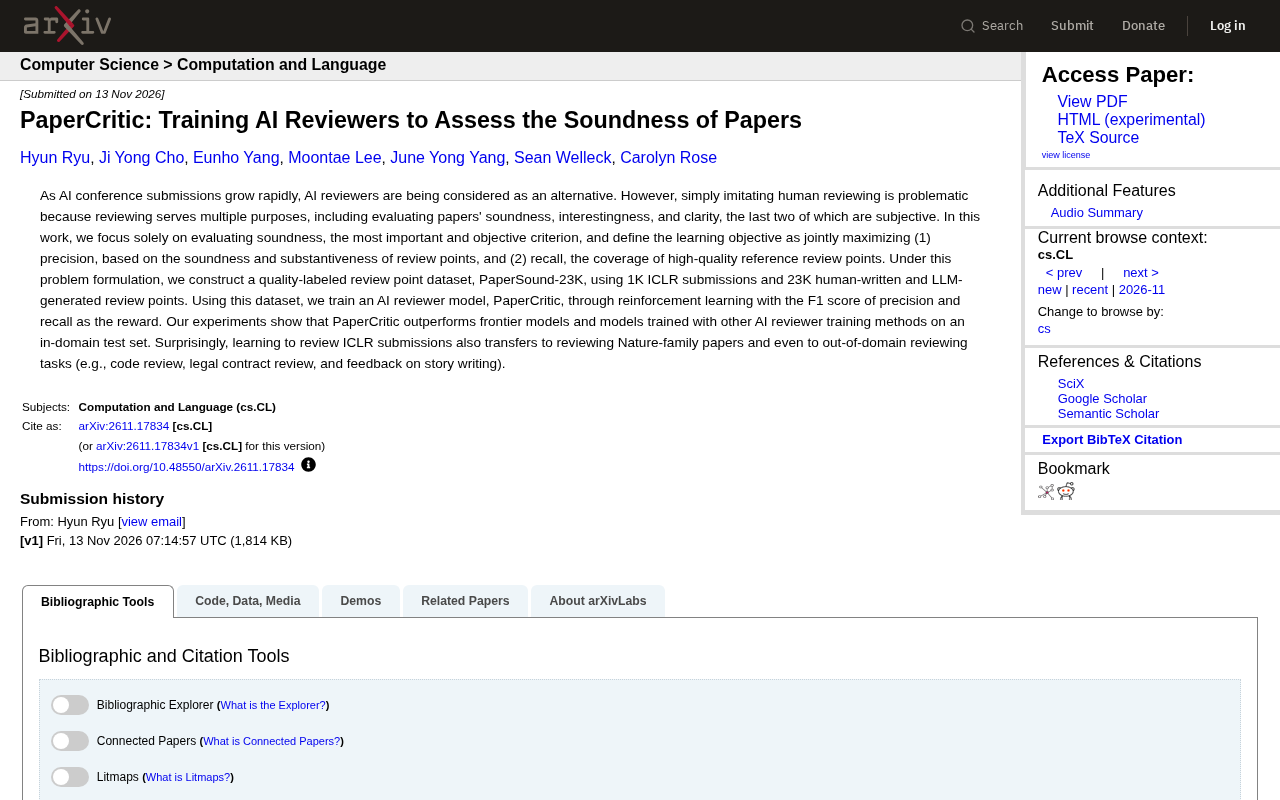
PaperCritic: Training AI Reviewers with Reinforcement Learning to Focus on Assessing Paper Soundness
PaperCritic proposes an AI reviewer training method that evaluates only paper soundness: using the PaperSound-23K dataset and an F1 reward of precision and recall for reinforcement learning, surpassing frontier models on in-domain tests and transferring to Nature papers, code review, and legal contract review.
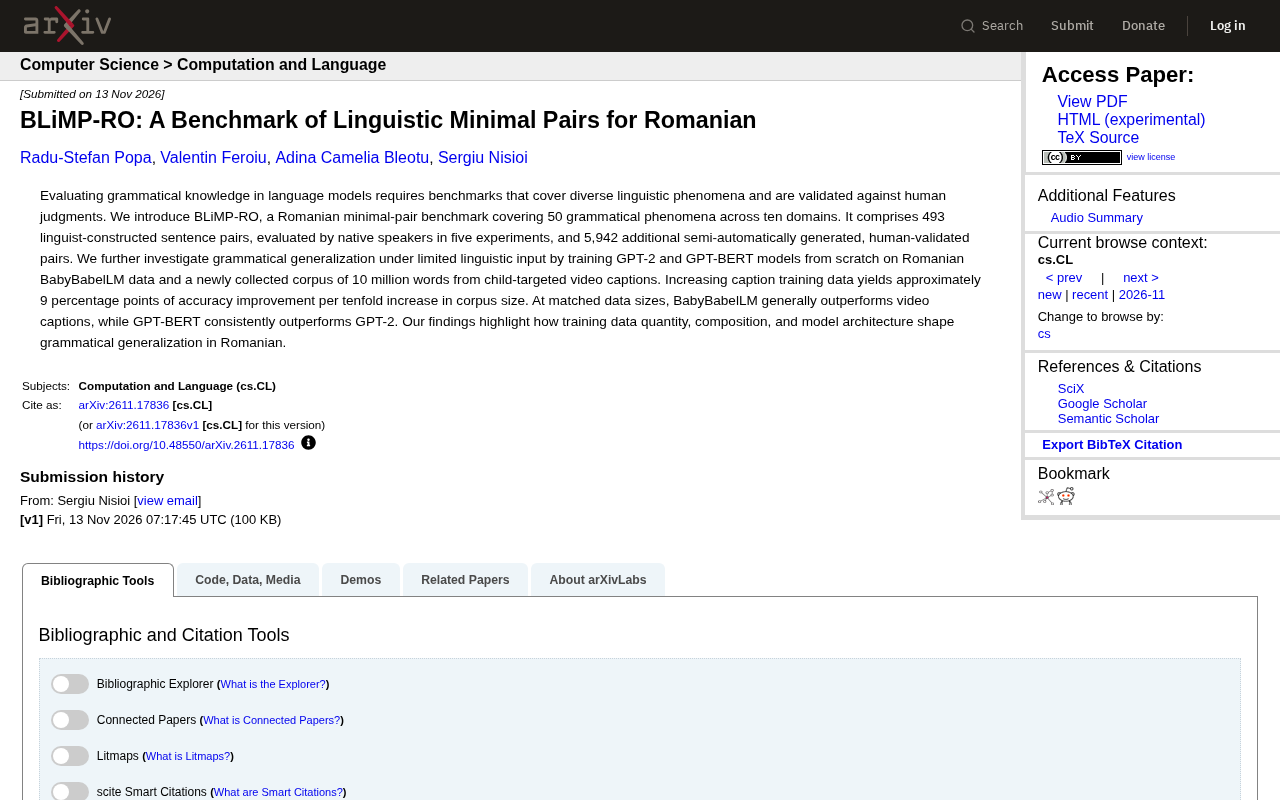
BLiMP-RO: A New Benchmark for Romanian Grammar Evaluation
BLiMP-RO is the first Romanian minimal-pair grammar benchmark, covering 50 grammatical phenomena with 493 linguist-built and 5,942 semi-automatically generated sentence pairs. The study also reveals how training data scale, composition, and model architecture affect grammatical generalization.

Google Gemini 4 Hydrogen Released: A Double Win on Speed and Cost, the New King of Everyday AI Tasks
Google releases the lightweight Gemini 4 Hydrogen model, matching Anthropic Sonic 5.5 and OpenAI GPT 6.1 Tera on coding and agent tasks—faster and at about one-third the cost—plus Orchestrator lets Carbon and Hydrogen divide the work.

Google Releases Gemini 4 Hydrogen: Double the Speed, Drastically Lower Costs, the Flash Path Becomes the New Ace
Google releases Gemini 4 Hydrogen, replacing 3.8 Flash: 2.5x faster, 12-23% fewer tokens, 5x fewer fabrications, new X-High level, and full availability at launch.

Open-Source Memory Plugin Dream Recall: Making AI Truly Remember You
Open-source memory plugin Dream Recall v0.38.3 brings cross-window persistent memory to DSH: seven memory types stored structurally, dream mechanism actively organizing conversations, forgetting markers that let memories fade without vanishing. Open source and self-installable, so AI opens with last time's experience.

Big Fat Fish QQ Plugin Update: Listen More, Talk Less, and Cross-Machine Collaboration
Big Fat Fish QQ plugin update: OneBot-based private and group chat access, independent personas, context enrichment, At completion, cross-drawing references, plus a multi-device collaboration plugin for encrypted cross-computer connections, remote drawing, and file transfer.

Jensen Huang: China's Open-Source AI and Talent Scaling Are Formidable
Jensen Huang at GTC Berlin discusses China's open-source AI and talent scaling, DeepSeek's $38 per GPU-hour compute economics, open-source post-training and hybrid AI, plus the AI jobs narrative and data center community relations.

DeepSeek Extends Long Conversations to 7 Days, Gemini 4 Free API and Qwen 4 Song Painting Interaction
DeepSeek extends long-conversation inactivity from 72 hours to 7 days; Gemini 4 Hydrogen opens a free API with million-level context; Qwen 4 turns a Southern Song painting into an interactive scroll; Claude Haiku 5.5 pushes low pricing; Tencent open-sources LoopForge; OpenCut surpasses 98,000 stars.

8 AI Models Debate Open vs. Closed Source: Consensus and Divergence on the AGI Path
Eight AIs debate open vs. closed source for AGI, agreeing openness is the foundation and four danger conditions trigger exceptions, differing only on the default for the strongest capability layer.

DeepSeek's Continuous Open Sourcing: How Liang Wenfeng's Ecosystem Strategy Is Driving Closed-Source Giants Crazy
DeepSeek continues open-sourcing and opens its APP API; a Bilibili video analyzes how Liang Wenfeng's open-source path uses community co-building to counter closed-source giants' product packaging and subscription models, and explores the real boundaries of this ecosystem competition.
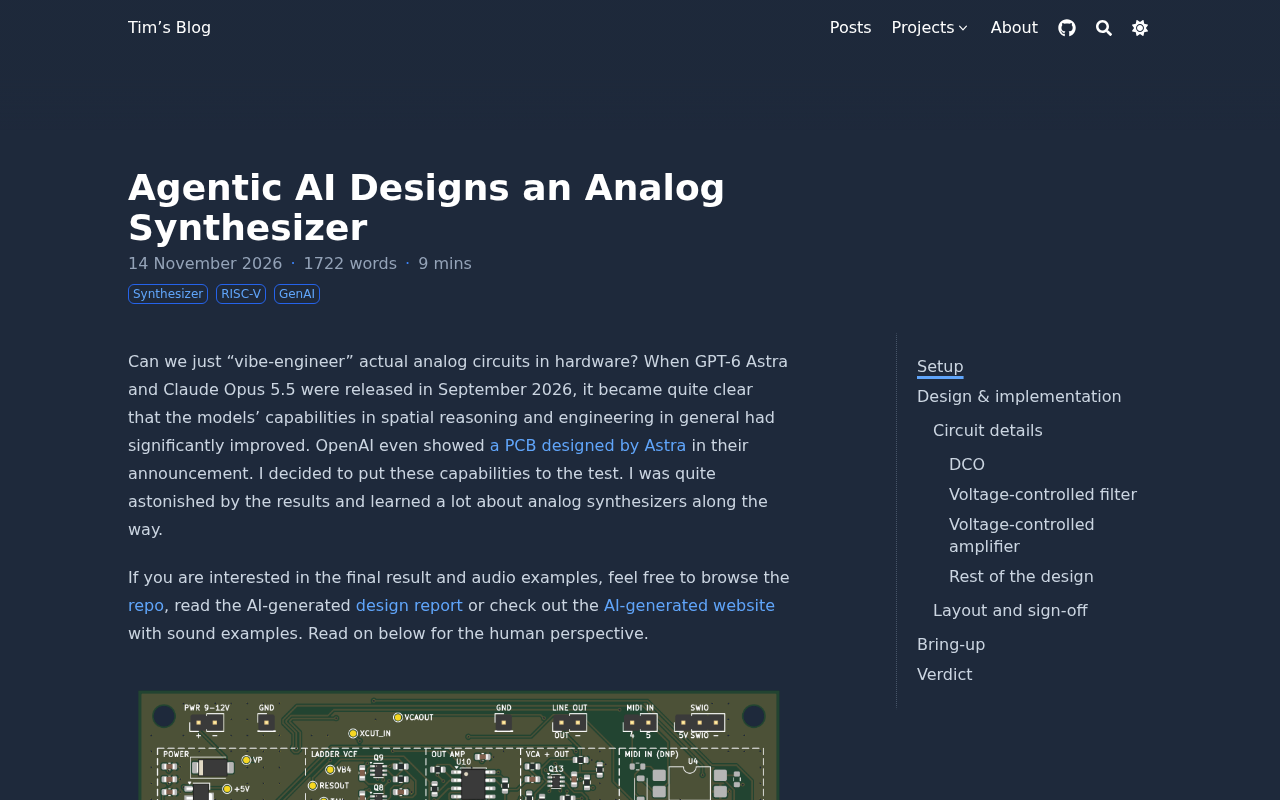
Agentic AI Takes On Analog Synthesizer Design: A New Frontier in Autonomous Agent Hardware Design
A Hacker News discussion on Agentic AI designing an analog synthesizer. We analyze agents' task decomposition in hardware design, real-world constraints of analog circuits, and what this exploration means for putting AI into practice.
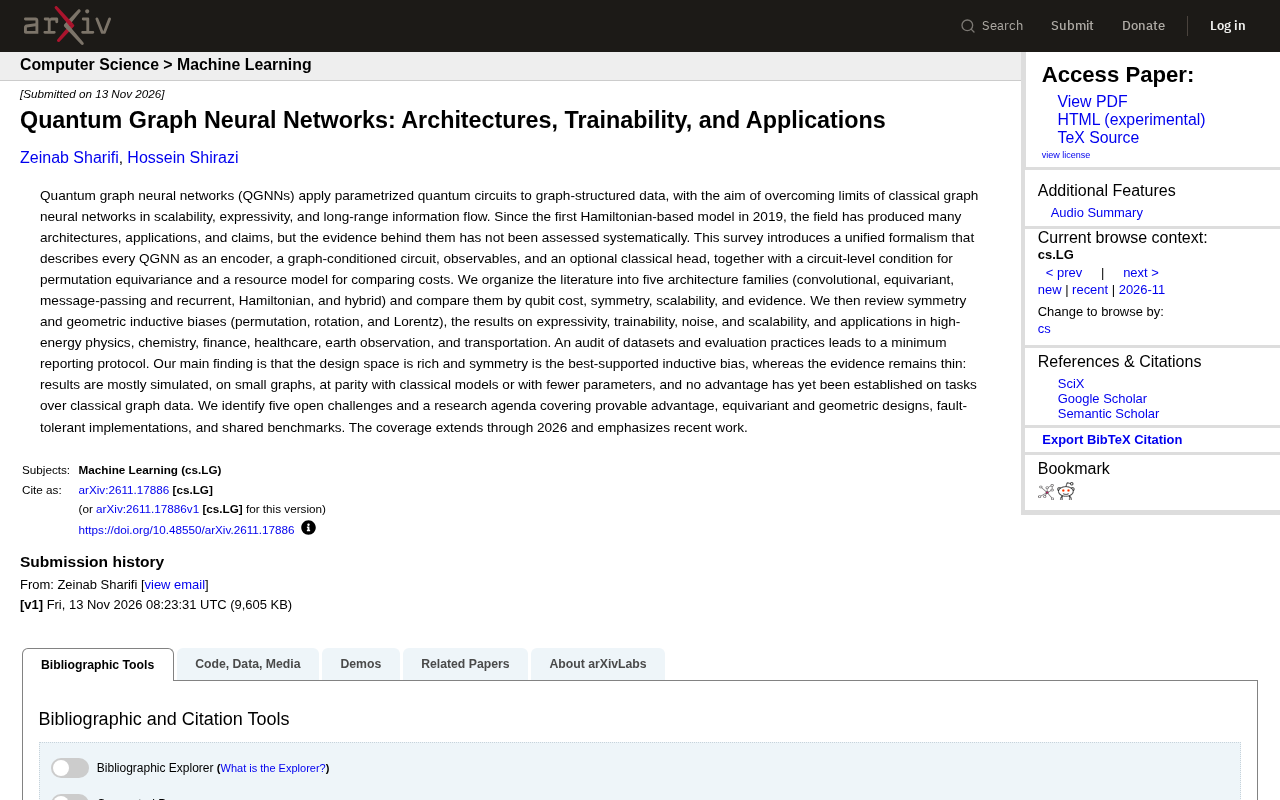
A Survey of Quantum Graph Neural Networks: Architectures, Trainability, and Applications
This QGNN survey unifies formalization, classifies five architecture families, assesses symmetry, expressiveness, trainability, and noise, audits application evidence, and notes that quantum advantage on classical graph data tasks is not yet established.

Theory of Expert Sharing: Local Error Reduction ≠ Final Output Improvement, MoE Multi-Step Reasoning Risk Reversal
MoE shared experts can reduce local prediction error, but new research reveals local gains may not translate to final output improvement, and risk reversal can occur. The article analyzes expert sharing theory, end-to-end error bounds, and experimental evidence, offering an evaluation framework for multi-step reasoning system design.

Machine Learning Relay Protection Assessment: Misoperation and Failure-to-Trip Risks Behind High AUC
PROTECT-90 dataset evaluates three ML fault detectors: AUC above 0.999 but failure-to-trip rates differ by two orders of magnitude; false-trip rates 0.12-0.16% per window; high fault resistance correlated with failure-to-trip.
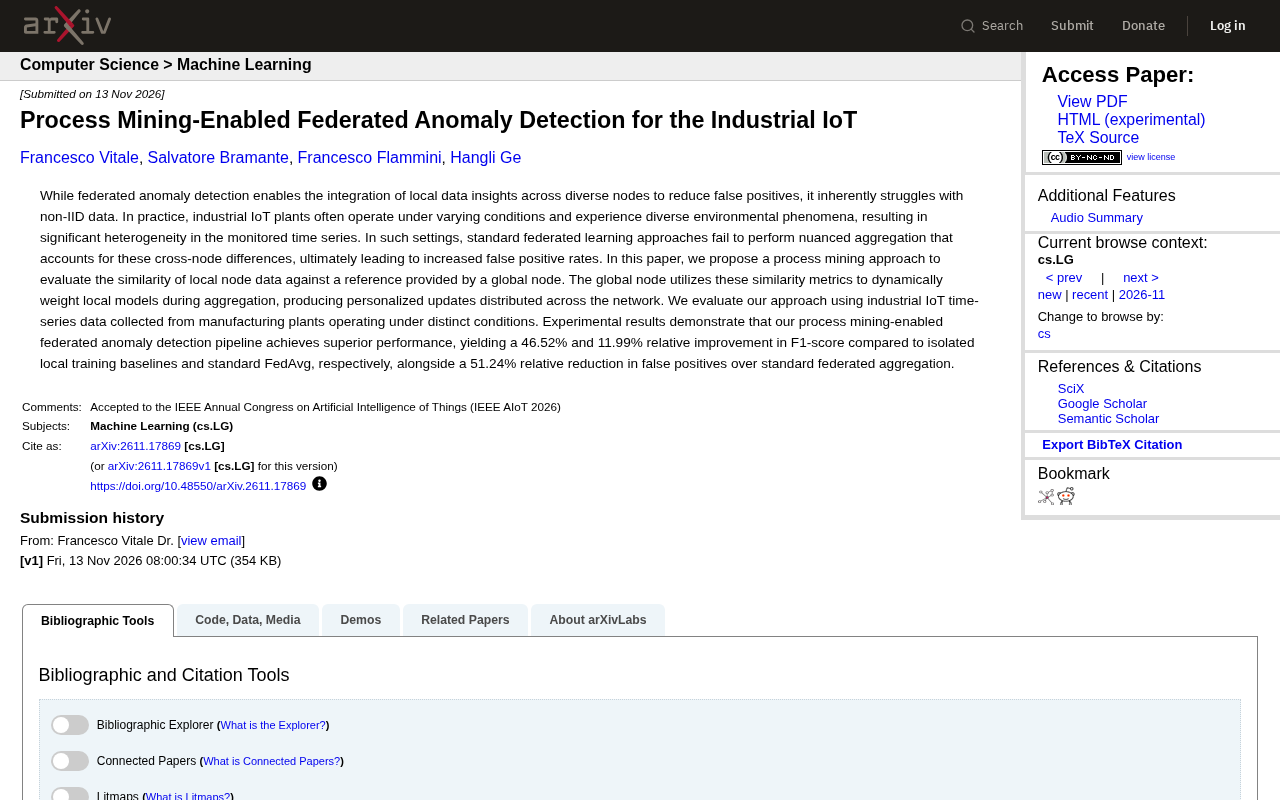
Process Mining + Federated Learning: A New Breakthrough in Industrial IoT Anomaly Detection
This article interprets a recent paper: using process mining to assess industrial IoT node data similarity and dynamically weighted federated aggregation, improving F1 by 11.99% over FedAvg and reducing false positives by 51.24% in non-IID settings.

Multimodal Person Concept Model: Robust Identity Recognition with Few-Shot Data
This paper introduces a multimodal person concept model using nonparametric Bayesian generative models and CLIP/CLAP features to learn person concepts from few unlabeled observations, achieving 0.89 average recognition accuracy across eight varying conditions, offering new ideas for robust identity recognition in service robots.

Are New Models Increasingly Hard to Jailbreak? Abliteration Effectiveness Does Not Uniformly Decline
A systematic study of five open-source model pairs finds that Abliteration effectiveness on newer models does not uniformly decline, but depends on model family, method, and search budget. Direction-based methods and ARA diverge markedly, and a single audit may yield opposite conclusions.