#AI编程
9361 related articles
AWS AgentCore Gateway: Connecting AI A…
AWS AgentCore Gateway: Connecting AI Agents to Enterprise Backends with MCP
How AWS AgentCore Gateway acts as a primary MCP server to aggregate REST APIs, Lambda, and existing MCP services? Analyzing its AST real-time mapping, zero cold start, semantic search for tool overload, session isolation, and key injection security design, plus the architectural approach to decoupling enterprise AI agents from backends.

Cognition SWE-2 in Practice: One Prompt to Handle the Whole Product Launch Process
Analyzing a YouTube creator's prompt for using Cognition SWE-2 to launch a product: a landing page, seven-email sequence, and non-buyer follow-up tool, plus how the 'test and report' constraint changes AI delivery quality.

AI Coding Agents Can Write Code, but Who Verifies Reliability?
AI coding agents can write code, but code generation is not software engineering. A junior full-stack developer proposes a seven-step workflow, stressing that verification cannot be outsourced to AI and asking how much autonomy agents should get, how to verify AI code, and which skills junior developers should prioritize.
 Tech Frontiers
AI Agents for Absolute Beginners: A Practical Guide to LLM Prompt Engineering
Zero-base guide to building AI agents on ByteDance's Coze platform—covering LLM fundamentals, prompt engineering, workflow design, hands-on projects, and job-market insights for students and career switchers.

Gym-Anything: Building Robot Simulation Environments with Coding Agents
Gym-Anything for Robotics lets coding agents automatically create robot simulation environments, selecting tasks by GDP data to build the RoboWorld benchmark with 25 simulations and 200 RL environments; frontier models average only 0.06 reward.
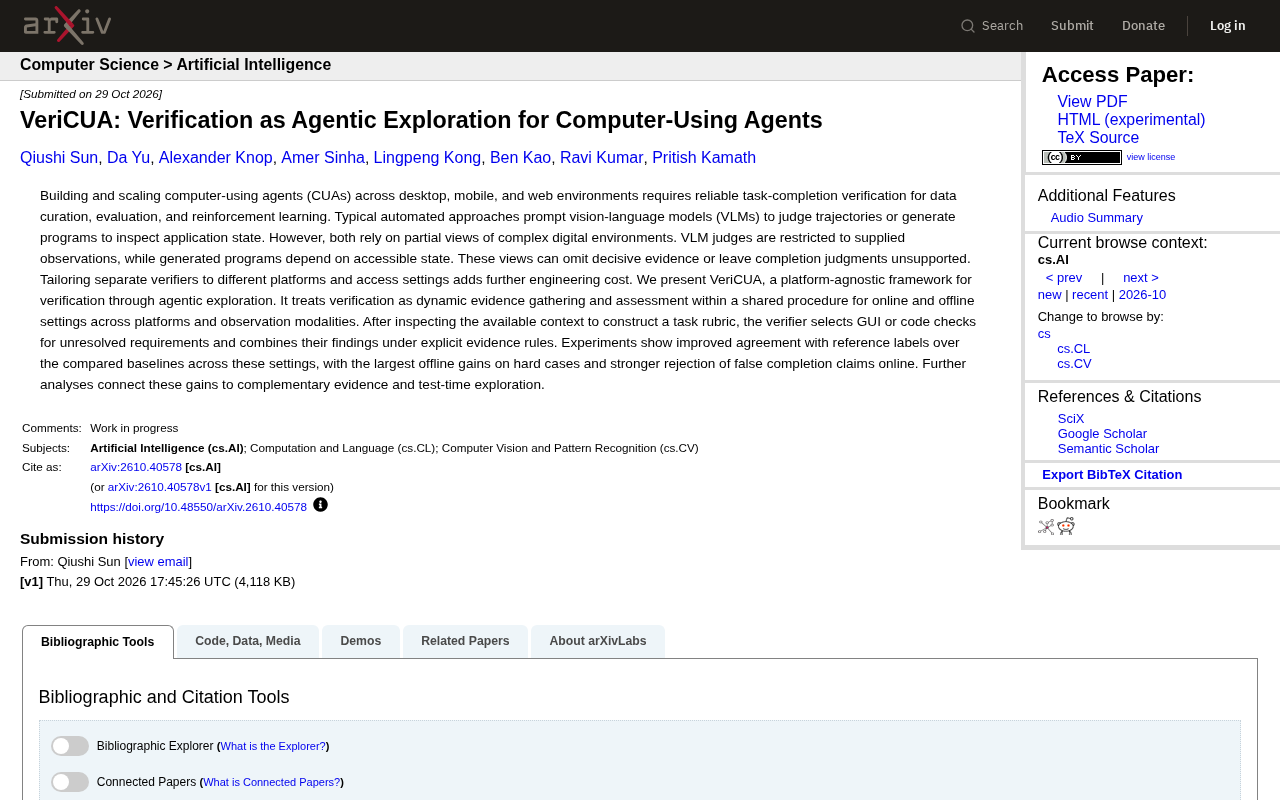
VeriCUA: Redefining Verification for Computer-Using Agents Through Agentic Exploration
VeriCUA proposes a new framework treating verification as agentic exploration, using dynamic evidence collection to solve task completion verification for computer-using agents across desktop, mobile, and web, with better performance on difficult cases and rejection of false completions.

PIVOT: How Online Teacher Correction Breaks Through the Sparse Reward Bottleneck of RLVR
PIVOT combines online teacher correction with token-level KL supervision to break the sparse reward bottleneck of RLVR, raising avg@8 on logic game benchmarks from 19.5% to 35.6%—nearly doubling it.

Switching from Cursor to Claude: A Developer's Hands-On Experience
A Reddit user shares their experience switching from Cursor to Claude, praising Claude with the Opus model and its longer 5-hour and weekly usage limits. This article analyzes the motivations behind developer migration and competition trends in AI coding tools.
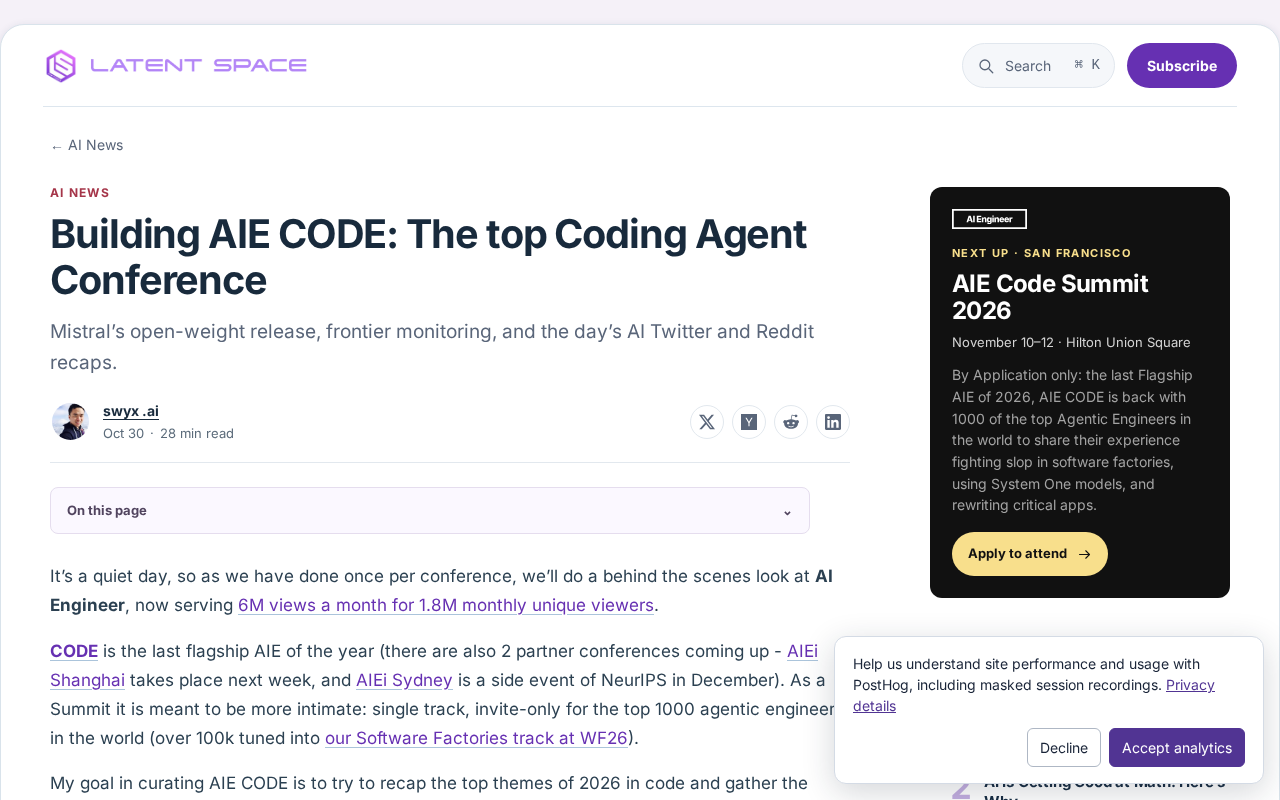
Mistral's New Open-Weight Models and Highlights from the AI Coding Agent Conference
Mistral releases open-weight models, and the AIE CODE coding agent conference focuses on engineering implementation. This article covers what open-weight models mean for AI coding, frontier monitoring, and the day's community discussions.

AI Daily: Mistral's Trillion-Parameter Model Goes Live, OpenAI Rolls Out Perks
AI Daily Issue 86: Mistral Large 4 trillion-parameter multimodal model launches on API with open weights by month's end; OpenAI opens AutoReview for free and beta-tests Decisions API; Google open-sources 191MB on-device multimodal embedding model Embedding Gemma 2; Perplexity cuts decision model API to 2 cents per million tokens.

Codex Pro Quotas Doubled as GPT-6.2 and Qwen4 Both Tease New Developments
Codex Pro quotas doubled as the GPT-6.2 codename and Qwen4 launch teaser surfaced the same day; Mistral Large 4 opens 1.05T-parameter weights, plus Tencent BuddyOne, Doubao enterprise edition, and updates across voice and robotics models.

Claude Code v2.1.314 Update Analysis: Tighter Permissions and Stability Fixes
Claude Code v2.1.314 adds permissions.blockWritesOutsideWorkingDirectories to block writes outside the working directory, IdP group routing and Bedrock guardrail tracing for enterprise gateways, and fixes for claude -p silent failures, Bedrock multi-image sessions, vim mode, and VS Code issues.

GPT-6.1 Terra Price Cut 50%, Mistral Large 4 Opens Up Trillion-Parameter Weights
AI Daily Issue 40: GPT-6.1 Terra cuts prices 50% with a computer-operation focus, Mistral Large 4 opens ~1T parameter weights, OpenAI monitoring warns 30+ hours early, Gemini 4th Gen Carbon limited release, Android Studio supports 40+ coding agents.
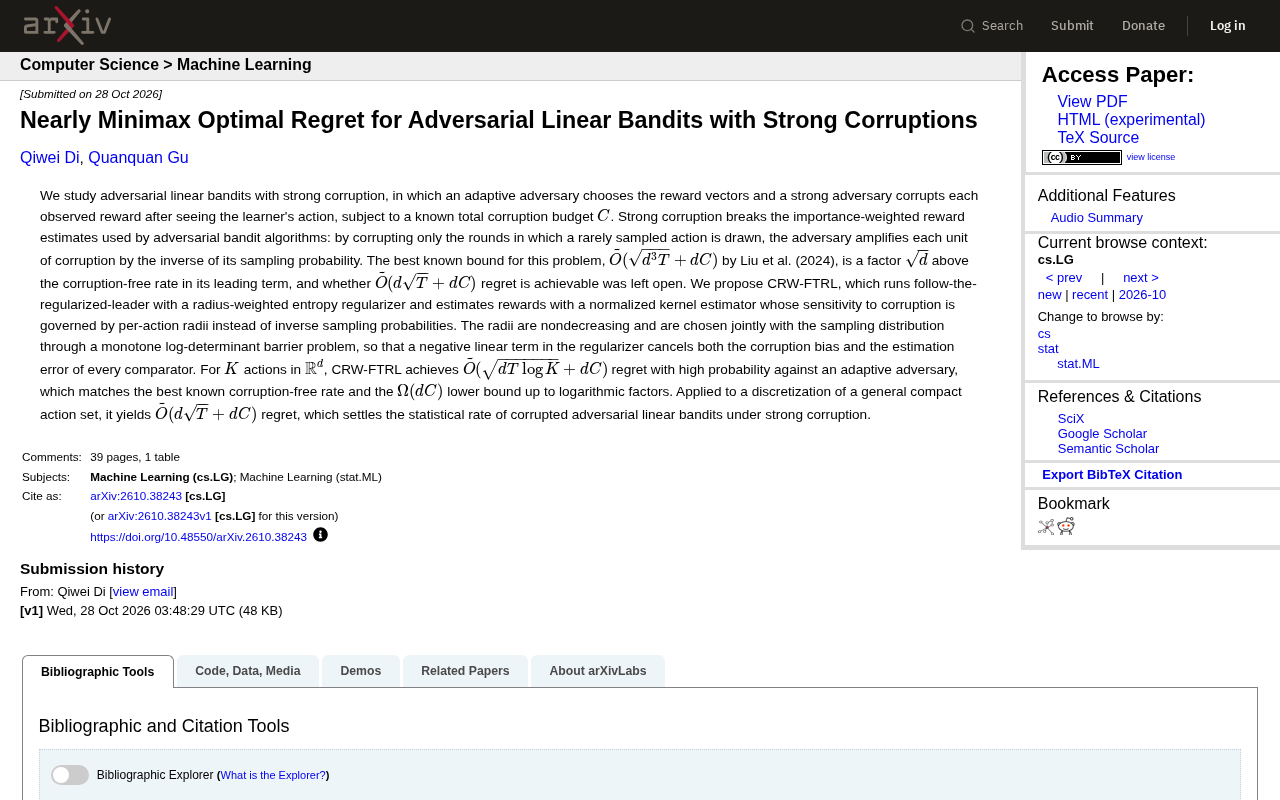
Strong-Corruption Adversarial Linear Bandits: CRW-FTRL Achieves Near-Minimax Optimal Regret
Explaining the new CRW-FTRL algorithm for strongly corrupted adversarial linear bandits: it uses radius-weighted entropy regularization and a normalized kernel estimator to raise the regret upper bound to Õ(√(dT log K)+dC), matching the corruption-free optimal rate and the Ω(dC) lower bound, resolving the open problem left by Liu et al.

ParaTTT: Parallelizing Test-Time Training Layers for Deep Memory
ParaTTT parallelizes deep nonlinear memory in test-time training layers via iterative refinement of gradient trajectories, achieving chunk parallelism, significantly faster training, and performance on par with linear recurrences and Transformers.

The Endgame of FSDP Communication: TIDE Zero-Copy Collective Communication Optimization
TIDE zero-copy collective communication optimizes FSDP2 layout conversion overhead, reducing step time by up to 27.1% on models like Llama-3.1 70B, cutting SM time by 12.5-14.5x, and significantly lowering communication-computation interference.

Skeleton Coding: Taming AI Coding Agents with Program Structure
Skeleton Coding lets developers and AI agents jointly specify program structure, theoretically reducing required tests exponentially, cutting average test error by 48.4%, narrowing model gaps, and lowering costs.

3DCodeEdit Benchmark: Instruction-Driven 3D Program Editing, Best Model Success Rate Below 60%
3DCodeEdit benchmark contains 2,592 instruction-guided 3D program editing tasks across 108 Blender programs. 17 models average only 37% success; best models under 60% on structural edits. Multi-turn feedback significantly improves performance, with a 27B model surpassing a 2.8T model using critic feedback.

EasyProver: How Recursive Agents Tackle Formal Verification of Real-World Code
EasyProver uses recursive agents, asynchronous search, and elastic elaboration to achieve formal verification in Lean, proving 669/672 problems on PutnamBench, and introduces Aegis, a benchmark for real Rust implementations, with a 52.7% pass rate on a 2,000-statement sample.

Accumulating Pruning Constraints: New Exact Polynomial-Space Algorithms for Max 2-SAT
New research proposes accumulating pruning constraints to exactly solve Max 2-SAT in polynomial space, achieving exponential speedups on biased-variable, semi-random, and regular expander graph Max-Cut instances, with possible generalization to general formulas.