#AI编程
9426 related articles

The Complete DeepSeek Harness Tutorial: From Installation to Advanced Agent Modes
A complete DeepSeek Harness tutorial: Node.js installation, API Key setup, workspace management, and a deep dive into Standard, PTC, and Collection-Resolution modes with real-world Token comparisons.
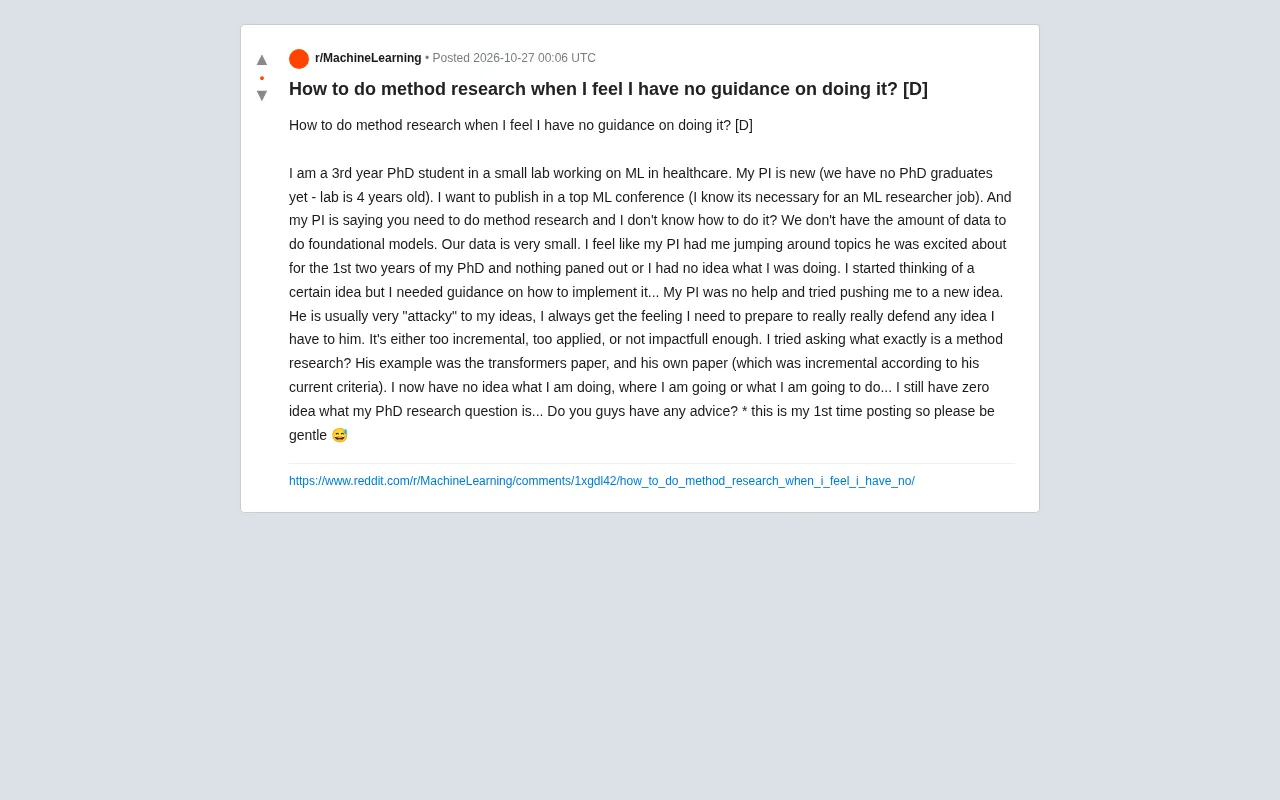
The Doctoral Student's Method Research Dilemma: When Even the Advisor Has No Answers
A healthcare ML PhD student on Reddit describes an advisor who can't define method research, limited lab data, and aggressive feedback. The article analyzes the blurry line between method research and incremental improvement, explores method innovation under small data, and offers practical advice on self-training without guidance and communicating with advisors.

Breaking the VRAM Bottleneck: ZeRO-3 + LoRA Enables Large-Scale Self-Distillation
Reddit open-source project sdft_zero3 uses LoRA shared backbone and dual adapters to enable large-scale self-distillation under ZeRO-3, solving the EMA teacher VRAM bottleneck.

The Most Complete Hermes Agent Practical Tutorial on Bilibili: From Beginner to Project Integration
Based on the Bilibili Hermes Agent course syllabus, this article outlines the complete path from basics and architecture to installation, configuration, and MCP access, and explains the technical points of four practical projects: news push bot, Python library integration, automated blog setup, and scheduled code review.

Dify in a Week: 30+ Enterprise-Level Projects to Master AI App Building
A complete Dify learning path based on a Bilibili course outline: Windows Docker deployment, MySQL setup, LLM integration, chatbot, Agent, Chatflow/Workflow nodes, and app publishing, with 30+ enterprise case directions.

Bilibili's Most Detailed Codex Walkthrough: From Installation and Configuration to Real-World Pitfall Avoidance
Key takeaways from Bilibili's most detailed Codex tutorial: GPT account registration, desktop install path pitfalls, fixes for 403 and token exchange errors, Plus 5-hour quota explained, plus practical advice on permissions and Pro upgrades.

Codex Practical Tutorial: From Plan Mode to Goal Mode, Mastering AI Programming
Drawing on a Bilibili practical tutorial, this guide details Codex's function area and workspace, Plan Mode vs. Goal Mode, permission choices, and Token consumption control.

How Law Firms Can Build Legal Tools with Codex: Inside Sullivan & Cromwell's Approach
OpenAI's video shows how Sullivan & Cromwell uses Codex to build custom legal tools: input draft contracts and precedents, quickly generate issue memos and track changes markup, and deliver to clients after lawyer review for faster review and deeper analysis.

URL as File: AI Coding Reshapes Software Storage and Privacy
The Vergecast talks with Paul Ford: tinylittleoffice packs document data entirely into the URL, with no server. How AI coding revives lightweight software and redefines privacy and ownership.

GitLab CI/CD in Action: Using a Pipeline to Catch the 'Free Shipping Over ¥199' Java Bug
A hands-on GitLab CI/CD demo showing how to catch a Java mall 'free shipping over ¥199' boundary bug: write tests first to lock expectations, let the pipeline run tests, package, and deploy, use failed logs to pinpoint the exactly-at-threshold order overcharged ¥10, and verify the running service uses the new build.

Understand Diffusion Models in 1 Hour: From Theory to Code
Understand diffusion models (Diffusion Model) in one article: from GAN's pain points, detailed forward noising and reverse denoising math derivations and code implementation, including UNet structure, loss function, and sampling process—ideal for beginners to get started quickly.

Diffusion Models for Beginners: From DDPM Principles to UNet in Practice
A systematic explanation of diffusion model (DDPM) principles, including mathematical derivations of forward noising and reverse denoising, plus UNet training and sampling code. Compares with GANs to help readers understand advantages and practical points—ideal for beginners.

AI Agents Keep Making the Same Mistakes? Try Looking for Common Ground
AI agent failures never seem to end? A developer offers a new perspective: many seemingly different failures may stem from the same pattern—the agent treats unchecked things as checked. This article analyzes the implications of this hypothesis for agent engineering practice, explores why fixing bugs one by one has limited effect, and how to build verification into the system level.

Is the Exponential Time Hypothesis Disproven? A Major Shockwave in Theoretical Computer Science
A paper claiming to disprove the Exponential Time Hypothesis (ETH) has drawn attention on Hacker News. This article explains ETH's theoretical status, the potential impact of a disproof, and why the community is cautious about such a disruptive claim.
Greptile Uses GPT-6 Astra to Extend Defect Detection Beyond Code Review
Greptile uses GPT-6 Astra to extend defect detection from code review to user workflow testing, while Daybreak strengthens security and Codex reduces rework. This article analyzes the division of labor among the three models and its industry significance.

Pharo 14 Released: The Modern Evolution of Open-Source Smalltalk
Pharo 14 officially released: the open-source Smalltalk environment gets a progressive update. This article covers its positioning, toolchain improvements, community feedback, suitable scenarios, and upgrade advice.

Diffusion Models: From Beginner to Expert — Theory Derivation and DiT Source Code in Practice
A zero-to-expert diffusion model learning path: master forward diffusion and reverse generation theory, work through DiT source code line by line, and explore paper innovations in acceleration and lightweighting.

Diffusion Models from Scratch: A Complete Derivation from Adding Noise to Denoising
A beginner-friendly guide to diffusion models: from GAN limitations to full derivations of forward noising and reverse denoising, why neural networks predict noise, plus UNet and code.

Diffusion Models for Absolute Beginners: A Learning Path That Avoids Detours
A zero-background diffusion model guide: from core math derivations to hands-on DiT lightweight toolkit source code, covering forward diffusion and reverse generation logic, close reading of acceleration and structural optimization papers, helping you avoid detours and close the loop between theory and source code.

Bilibili Hot Pick: A Hands-On Guide to Mastering Diffusion Model Principles and Source Code from Scratch
A Bilibili-recommended diffusion model learning path: start from core principles and derivations, debug source code line by line with a lightweight DiT toolkit, and close the loop from theory to innovation. Ideal for beginners to systematically master Diffusion Models and land paper projects.