#AI编程
9435 related articles

AI Agentic Systems: Why It's the Must-Have Skill Right Now
Starting from a Reddit discussion, this article breaks down the core concepts and engineering essentials of AI Agentic Systems: autonomous loops, tool calling, termination conditions, observability, and evaluation—plus a pragmatic path to getting started, explaining why building Agent systems is becoming a must-have skill for engineers.

Cline CLI v3.0.74 Released: Task Resume and Model Catalog Overhaul
Cline CLI v3.0.74 fixes duplicate task runs, Hub health check hangs, and Gemini free-key 429 errors, plus a major model catalog refresh with new providers and defaults.

Cline Agents SDK 0.2.0 Released: AI Coding Agent Toolchain Evolves Further
Cline releases @cline/agents 0.2.0, continuing Agents SDK iteration. This article interprets the release, its practical implications for AI coding agent developers, and usage advice for early SDK versions.

Cline Core SDK Releases Version 0.2.0: The AI Coding Toolchain Takes Another Step Forward
Cline Core SDK releases version 0.2.0—the version jump hints at new features or major refactoring. This article analyzes the update's potential impact on AI coding workflows and offers upgrade advice for developers.

Cline Releases @cline/llms 0.2.0: Parsing the LLM SDK Update
Cline releases @cline/llms 0.2.0, a minor LLM SDK update. We analyze the release info, namespace positioning, upgrade considerations, and the engineering habits and documentation gaps behind open-source AI toolchain version cadence.

Cline SDK v0.2.0 Update: Session Reconnection, Slimmer Retries, and a Model Catalog Overhaul
Cline SDK v0.2.0 released: sessions now reattach to the active runtime, model retries cut from 5 to 3, Gemini native search disabled, and the model catalog trimmed from 7,041 to 6,457 with new default models.

Cline Releases @cline/shared 0.2.0: AI Coding Tool SDK Update
Cline releases @cline/shared 0.2.0, a shared SDK update for the AI coding assistant. Release overview, ecosystem significance, and upgrade notes for developers.

Cline UI SDK v0.2.0 Released: The Independent Evolution of AI Coding Tool Component Libraries
Cline's UI component library @cline/ui releases v0.2.0, marking the SDK-ification of AI coding tool interfaces. This article analyzes the architectural signals, ecosystem implications, and integration advice for developers.

Rounding Position Alignment: A New Method for Stable LLM Reinforcement Learning
Research proposes aligning rounding positions of RoPE, SwiGLU, and RMSNorm in inference and training to stabilize LLM reinforcement learning under BF16, preventing collapse without changing inference engines or learning objectives.

Why Is Multi-Agent Collaboration So Much Harder Than Single-Agent?
Multi-agent collaboration is far harder than single-agent? This article analyzes the real engineering challenges of multi-agent systems across four dimensions—communication costs, error cascades, emergent behavior, and missing debugging tools—and offers a practical path starting from simple scenarios.

Learn AI Agent Development for Free: Build a Minimal Conversational Agent from Scratch
Based on Xiao Fu Ge's free Bilibili course, this lesson covers the five-stage AI Agent learning path, OpenAI protocol integration, a lightweight Java project, and building a minimal conversational agent.

Nanbeige Releases 33B Open-Source Agentic Coding Model with 512K Context
Nanbeige LLM Lab releases Nanbeige4.3-33B, an open-source Agentic coding model: 33B dense, 512K context, Apache 2.0, 80.9 on Terminal-Bench 2.1, distilling a 3B model.

Let the Agent Be the Director: A Vision for a Fully Local AI Production Workstation
A Bilibili creator envisions building a local AI director workstation with NVIDIA RTX Spark, letting an Agent orchestrate script, storyboard, video generation, voiceover, auto-editing, and review for full AI production.

Build an Agent Yourself: The Best Path to Understanding AI Agents
Want to truly understand AI Agents? This article shows how to build a minimal Agent from scratch, breaks down the LLM/Harness division of labor, recommends learning frameworks like PiAgent and DeepSeek Harness, and outlines eight progressive stages plus the relationship between RAG and Agents.
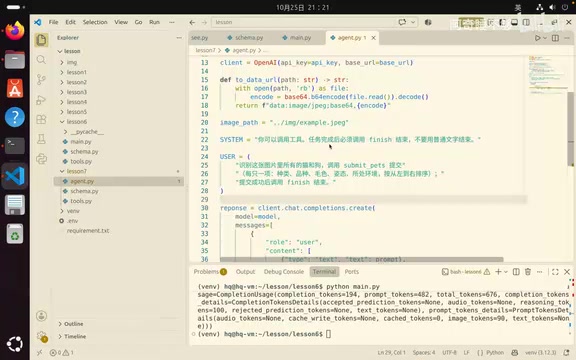
Building a Minimal Agent from Scratch: A Hands-On Guide to Writing AI Loop Invocation Code
Follow a Bilibili tutorial to build a minimal AI Agent from scratch: define tool schemas and a finish signal, design system/user prompts, implement a loop with a max step limit, parse tool call results, and fix the bug where the loop does not exit after finish.
Kimi K3.1 Pro Hands-On: Can an Open-Source Model Challenge Opus 5.5?
Kimi K3.1 Pro tested against Opus 5.5 and DeepSeek V4.1 Flash: strong benchmarks, but MOBA game dev exposes weaknesses. Speed near Opus, cost near DeepSeek—the open-source value pick.

The Boundaries of Multi-Agent Handoff: What to Give, What to Hide?
In multi-agent workflows, how much context should a handoff include? This article breaks down a Reddit developer's firsthand experience: whether an atomic spec plus the target file is enough for the Coder, why the Reviewer must have the spec, and how to request a bounded excerpt of a named dependency when the slice is too narrow—distilling an actionable handoff judgment rule.

Three Stages of AI LLM Testing: The Testing Transformation from Assertions to Evaluations
AI LLM testing is shifting from assertions to evaluations. This article outlines the three-stage evolution—testing with AI, alongside AI, and AI itself—and explains why probabilistic outputs defeat traditional assertions, covering version pinning, three evaluation layers, and Promptfoo tool selection.

DeepSeek Harness: Taking AI Testing from Standalone Tools to a Team Platform
DeepSeek Harness changes AI testing collaboration with server-side operation and a plugin mechanism. This article analyzes its core differences from standalone tools like Codex and explores how test development can build team-level AI testing capabilities through platform thinking.

Building an AI Agent with AI: A Hands-On GitHub Data Query Project with MiniMax Code
A Bilibili creator demonstrates building an AI Agent with MiniMax Code: using GPT to break down tasks and generate prompts, multiple Agents work in parallel to collect GitHub repository data, store it, and enable natural language queries, showcasing AI coding tool invocation and autonomous decision-making.