#code search
20 related articles
·2 min
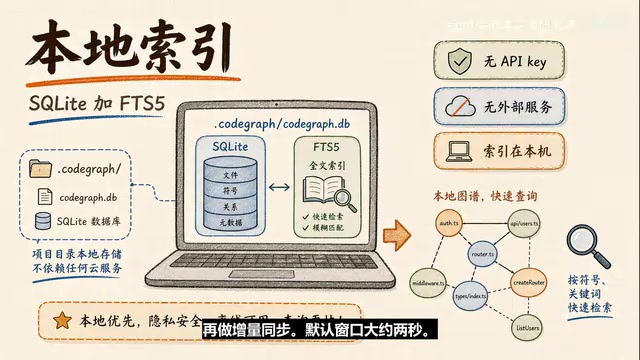
CodeGraph: Give Your Coding Agent a Code Map, Save 47% Tokens
CodeGraph is an open-source project with ~40K GitHub stars that uses Tree-sitter to build a local queryable code map, helping Claude Code and Cursor reduce 47% token usage and 58% tool calls.
Read more →

·4 min
Core Principles of Coding Agents: How Perception and Context Engineering Determine AI Coding Effectiveness
Deep dive into why coding Agents differ: perception lets Agents understand projects first, context engineering precisely filters information within limited token budgets.
Read more →
Complete Beginner's Guide to Cursor AI…
·4 min
Complete Beginner's Guide to Cursor AI: Three Modes Explained with Hands-On Demo
Learn Cursor AI editor setup, Agent/Ask/Manual modes, model selection tips, and build a full student management system from scratch in this step-by-step guide.
Read more →
Save 80% Tokens with Claude Code: Head…
·3 min
Save 80% Tokens with Claude Code: Headroom vs RTK vs LinCTX Deep Comparison
Deep comparison of Headroom, RTK, and LinCTX—three open-source context compression tools. Real tests show 80% token savings in Claude Code sessions.
Read more →
AI Large Language Models for Reverse E…
·3 min
AI Large Language Models for Reverse Engineering: A Workflow That Boosts Freelance Efficiency by 10x
Learn how AI LLMs revolutionize JS reverse engineering—automating encryption cracking, signature reconstruction, and parameter analysis to boost freelance scraping efficiency by 10x.
Read more →
 Tutorials
·3 min
Practical Guide to Configuring MCP Servers and Extensions in Gemini CLI
Learn how MCP servers work in Gemini CLI and how to configure them. Step-by-step guide using Context7 and Firebase extensions to expand AI coding capabilities.
Read more →
 Product Reviews
·2 min
Alibaba Qoder 1.0 Hands-On Review: A Project-Level AI Programming Assistant Driven by Natural Language
Deep analysis of Alibaba Qoder 1.0's core capabilities: end-to-end development via natural language with task decomposition, file-by-file modification, and automated testing.
Read more →
 Tutorials
·2 min
Practical Guide to Claude Code Context Management: compact, clear, and context Commands Explained
Detailed guide to Claude Code context window management: /compact, /clear, and /context commands with usage scenarios and optimization tips for AI coding productivity.
Read more →
 Tutorials
·3 min
From Claude Code to Codex: A Practical Guide to Diversifying Your AI Coding Tools
Learn how to integrate OpenAI Codex into your dev workflow alongside Claude Code. Covers pricing comparison, desktop setup, one-click migration, context management differences, and unique visualization features.
Read more →
 Expert Opinions
·3 min
Replit CEO Interview: AI Coding Models Are Plateauing, the SaaS Apocalypse Is Happening Now
Replit CEO Amjad Massad on AI coding models hitting a ceiling, competition shifting to product engineering, SaaS being replaced by AI Agents, the death of the IDE, and multi-model orchestration.
Read more →
 Tutorials
·4 min
Deep Dive into Claude Code's Agent Architecture: From Principles to Minimal Implementation
Deep analysis of Claude Code's four core agent modules: Agent Loop, Tool System, Skills, and Memory, with a TypeScript minimal implementation guide for frontend engineers transitioning to AI development.
Read more →
 Industry Insights
·4 min
Deep Dive into Claude Code's Open-Source Architecture: Six Core Design Principles and Engineering Practices Revealed
Deep analysis of Claude Code's open-source architecture: six core design principles including dual-loop mechanism, seven-step tool pipeline, four-layer token compression, multi-agent collaboration, and memory systems.
Read more →
 Product Reviews
·3 min
Gemini CLI V0.9.0 Update: Deep Dive into Interactive Shell and Codebase Agent Features
Deep dive into Gemini CLI V0.9.0's two core updates: Interactive Shell for seamless TUI programs like Vim and htop, and Codebase Investigator Agent for intelligent project-level refactoring with safe rollback.
Read more →
Product Reviews
Comprehensive Review of 10 Mainstream …
·4 min
Comprehensive Review of 10 Mainstream AI Coding Tools: How to Choose from Cursor to Claude Code
In-depth comparison of 10 AI coding tools including GitHub Copilot, Cursor, Claude Code, and Windsurf, analyzed across features, target users, and pricing to help developers choose the right AI assistant.
Read more →
Tutorials
Building AI Agents with Node.js: Repla…
·3 min
Building AI Agents with Node.js: Replacing Prompt Engineering with Function Calls
Learn how to refactor a Node.js AI Agent using Function Calls instead of prompt engineering. Covers tool definition via JSON Schema, the Agent Loop, and key implementation details from analyzing Claude Code.
Read more →
Product Reviews
Fitten Code MCP Launch: Connecting AI …
·2 min
Fitten Code MCP Launch: Connecting AI Agents to Unlimited External Tools
Fitten Code Agent now supports MCP protocol, enabling flexible integration with GitHub, Bing search, Excel, and other external tools to become a super AI programming assistant.
Read more →
 Tutorials
·2 min
Cursor AI Programming in Practice: A Complete Guide to Using Coding Agents Efficiently
A deep dive into Cursor's coding agent architecture and practical techniques, covering code search, feature development, debugging, code review, and custom configuration for efficient AI programming.
Read more →
 Research
·3 min
110K PRs Tested: Which of 5 AI Coding Agents Is Most Reliable?
Empirical study of 110K open-source PRs comparing 5 AI coding agents (GitHub Copilot, Claude Code, Devin) on merge rates, code survival, and long-term maintainability—revealing AI code's 50% one-year survival rate.
Read more →
 Tutorials
·3 min
Claude Code Beginner's Guide: Installation, Cost-Saving Solutions & Source Code Architecture Analysis
Claude Code beginner tutorial covering installation, common issues, low-cost alternatives for budget users, and deep analysis of 8 Agent design patterns revealed by the 510K-line source code leak.
Read more →
Tutorials
Agent Loop Explained: Solving Code Ref…
·3 min
Agent Loop Explained: Solving Code Refactoring Pain Points with the ReAct Pattern
Deep dive into Agent Loop, the core mechanism of AI coding tools. Learn how the ReAct pattern's reason-act-observe cycle enables autonomous multi-step code refactoring.
Read more →