Deep Dives
61 articles
Deep Dives
Claude Opus vs. Sonnet vs. Haiku: How …
·2 min
Claude Opus vs. Sonnet vs. Haiku: How to Choose the Right Model
Compare Anthropic's Claude Opus, Sonnet, and Haiku models across intelligence, speed, and cost. Practical selection guide with multi-model routing strategies.
Read more →
Deep Dives
ACP Protocol Explained: A New Open-Sou…
·2 min
ACP Protocol Explained: A New Open-Source Protocol Standardizing Communication Between IDEs and Coding Agents
Deep dive into ACP (Agent-Client Protocol): how Zed and Google Gemini standardize IDE-to-coding-agent communication, its architecture, and how it complements MCP.
Read more →
 Deep Dives
·3 min
Single-Agent vs Multi-Agent: A Three-Step Decision Framework for Choosing the Right Architecture
Based on Anthropic's engineering practices, a detailed three-step decision framework for single-agent vs multi-agent architecture: bottleneck identification, technical feasibility, and business value filtering.
Read more →
 Deep Dives
·2 min
Hermes Agent Deep Dive: An Open-Source AI Digital Worker That Learns
Deep dive into NousResearch's open-source Hermes Agent framework: memory systems, skill reuse, tool calling, security, deployment guide, and multi-agent collaboration.
Read more →
 Deep Dives
·2 min
AI Agent Development Methodology: A Complete Guide from ReAct to Enterprise-Grade Tech Stack
A deep dive into AI Agent development methodology, from the ReAct theoretical framework to a four-layer enterprise tech stack covering model services, Agent types, LangChain, and production deployment.
Read more →
 Deep Dives
·3 min
Claude Sub-agents vs Agent Teams: How to Choose Between Two AI Multi-Agent Collaboration Patterns
Deep comparison of Claude sub-agents vs agent teams: architecture differences, use cases, and real-world results. A Pokémon RPG case study shows how agent teams achieve 95%+ feature completeness.
Read more →
 Deep Dives
·3 min
Deep Dive into MCP Code Execution & Agent Skills: Compressing 150K Tokens Down to 2,000
Deep analysis of two MCP ecosystem breakthroughs: code execution compresses tool definitions from 150K to 2K tokens, and Agent Skills enable capability packaging and reuse.
Read more →
 Deep Dives
·2 min
MCP Protocol Explained: The USB-C of the AI World
Deep dive into MCP (Model Context Protocol): architecture, how it works, and security risks. Learn the key differences between MCP and Function Calling.
Read more →
 Deep Dives
·3 min
From Copilot to Agentic AI: Understanding AI's Evolution Through Four Stages
A systematic breakdown of AI's four-stage evolution from Chat Mode to Agentic AI, covering multi-agent architectures, ReAct framework, and MCP protocol.
Read more →
 Deep Dives
·3 min
Why Pure Vector Search Fails at Precision: A Deep Dive into Enterprise Hybrid Retrieval Architecture
Deep analysis of why vector search fails at exact keyword matching, with a breakdown of enterprise hybrid retrieval architecture for RAG: keyword search as safety net, vector search for UX, RRF fusion, and query routing.
Read more →
 Deep Dives
·3 min
Harness Engineering Explained: Building Stable and Efficient Work Systems for AI
Deep dive into Harness Engineering: how to build execution environments, toolchains, and feedback loops for AI. From Prompt Engineering to system-level engineering for stable AI production.
Read more →
 Deep Dives
·2 min
Agents Need Control Flow, Not More Prompts
Why do longer Prompts make AI Agents less stable? This article explains the control flow first architecture, replacing natural language control flow with code orchestration to boost multi-step reliability from 40% to over 90%.
Read more →
 Deep Dives
·2 min
What Is the MCP Protocol? Understanding the USB-C of the AI World
MCP (Model Context Protocol) is a unified standard for connecting AI models to external tools. This guide explains MCP's core concepts, practical value, and provides a quick-start tutorial.
Read more →
Deep Dives
Getting Started with RAG: A Complete G…
·3 min
Getting Started with RAG: A Complete Guide from LLM Hallucinations to Retrieval-Augmented Generation
A deep dive into RAG (Retrieval-Augmented Generation) technology, covering LLM hallucinations, data staleness, and limited expertise, plus RAG workflows, core components, and LangChain learning paths.
Read more →
Deep Dives
Using AI for Planning? You're Falling …
·2 min
Using AI for Planning? You're Falling Into the 'Always Agreeing' Trap
A game designer tested Doubao, GPT, and Gemini and found they always agree with you. This sycophancy bias turns AI into an echo chamber accelerator. Learn four principles for using AI correctly.
Read more →
Deep Dives
Neural Networks for Beginners: From Fu…
·1 min
Neural Networks for Beginners: From Fundamentals to Handwritten Digit Recognition
Understand neural networks from scratch. Learn input layers, hidden layers, forward propagation, backpropagation, gradient descent, with a handwritten digit recognition example.
Read more →
 Deep Dives
·4 min
The Four Stages of AI Agent Evolution: A Complete Guide from Copilot to Multi-Agent Collaboration
Deep dive into the four stages of AI Agent evolution: Chat, Copilot, Agent, and Agentic AI. Covers ReAct framework, Spring AI stack, and multi-Agent architecture design for 2025.
Read more →
 Deep Dives
·4 min
From Copilot to Agentic AI: A Complete Guide to Multi-Agent Collaboration Architectures
Deep dive into AI's four-stage evolution from Chat to Agentic AI, covering multi-Agent architectures, ReAct framework, and MCP protocol for developers.
Read more →
 Deep Dives
·3 min
98 Expert Agents Working in Concert: A Deep Dive into an Open-Source Multi-Agent Orchestration Framework
Deep dive into a trending open-source multi-agent framework with 98 expert agents, swarm orchestration, HNSW vector memory, autonomous learning, and Agent Federation for distributed collaboration.
Read more →
 Deep Dives
·4 min
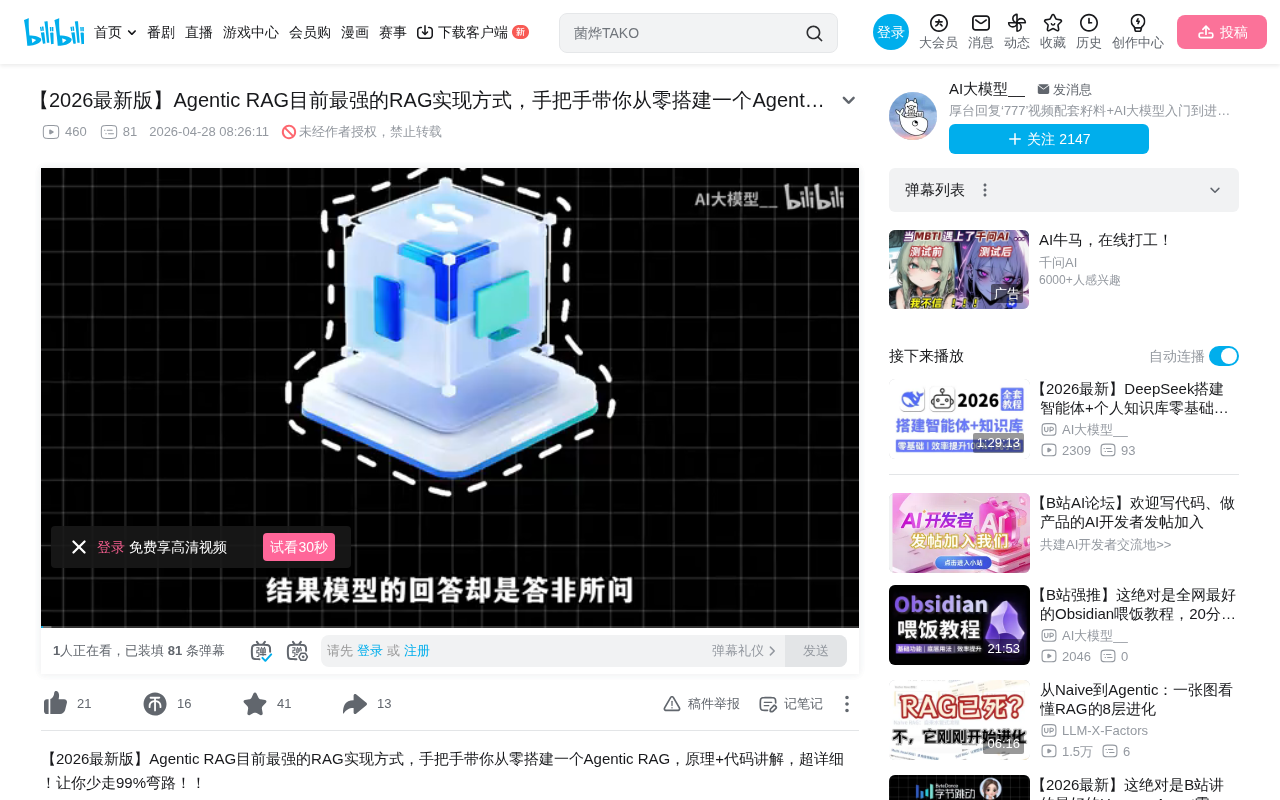
The Complete Guide to Agentic RAG: Principles and Code Implementation
Deep dive into Agentic RAG vs traditional RAG, covering tool calling, multi-step iteration, query rewriting, with LangChain and LangGraph code examples for building intelligent retrieval systems.
Read more →