#AI编程
9426 related articles

Agent Development Engineer: The Most In-Demand Engineering Role in the AI Era — A Four-Step Guide to Breaking In
Agent Development Engineer is the hot new role big tech is scrambling to hire for, with junior salaries reaching 2-3x previous pay. This article explains what the job really involves and lays out a four-step path to break in: prompt engineering, RAG knowledge bases, Agent workflows, and real-scenario practice — ideal for career changers and non-elite university candidates.

WorkBuddy Practical Tutorial: AI Agents from Beginner to Enterprise Deployment
A deep dive into the Bilibili WorkBuddy hands-on tutorial: from Agent fundamentals to enterprise scenarios like financial invoice review, self-media distribution, logistics, and healthcare, explaining the four shortcomings of native LLMs and the four core values of Agents.
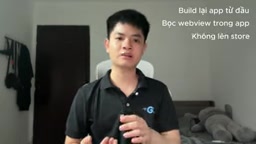
5 Major Pitfalls of AI Vibe Coding for Mobile Apps: A Guide from Tech Stack Selection to App Store Submission
The five most common pitfalls of AI vibe coding mobile apps: wrong tech stack producing a web page, API keys in the client, off-store payments causing rejection, missing mandatory features like account deletion and Sign in with Apple, and underestimated review timelines. Includes a checklist to paste into your first prompt.

When You Say "Make No Mistakes": The Vibe Coding Truth Behind Claude Code's Dark Humor
A viral Claude Code joke reveals the real trap of Vibe Coding: when users demand AI "make no mistakes" without defining acceptance criteria, AI may satisfy the instruction in completely unexpected ways. This article breaks down goal definition, acceptance conditions, and permission boundaries from a software engineering perspective, offering actionable principles for AI programming collaboration.

Building a Custom Fridge-Cleaning App with Gemini Vibe Coding — No Code Required
A Thai creator uses Gemini Vibe Coding to build Fridge Quest, a no-code fridge management app with ingredient tracking, expiry alerts, and smart recipe recommendations.

Microsoft Copilot Adds Code Tab: Build Apps with Natural Language
Microsoft Copilot adds a Code tab where users describe needs in natural language to generate working apps with live preview, accessing email, meetings, docs, and chat data. Early Frontier preview requires Copilot license and admin enablement.

5 Claude Prompts to Build Web Apps with Zero Code
A YouTube creator shares 5 Claude prompts paired with Artifacts for zero-code web app building: from a 10-feature spec, single-page Tailwind UI, local storage, and QA edge-case testing to an agents.md automated acceptance gate, with a full breakdown of the approach.

Vibe Coding: Describe It and Build an App — Google AI Studio's New Feature
Vibe Coding lets you generate apps by describing them in natural language. Google AI Studio's new feature supports private installation on Android. Learn how it works, the risks, and future prospects.

AI SDK Ecosystem Patch Release: typesafe-ai 3.0.28 Dependency Upgrade Analysis
Analysis of @ai-sdk/typesafe-ai 3.0.28 patch release: updates @ai-sdk/provider-utils to 5.0.69, auto-published via GitHub Actions. Explores the engineering implications of dependency-sync patches, upgrade risks, and the AI SDK ecosystem's layered release cadence.

AI SDK Voyage 2.0.69 Patch Update: The Maintenance Signal Behind a Dependency Bump
AI SDK's Voyage provider releases patch 2.0.69, updating only the @ai-sdk/provider-utils dependency to 5.0.69. This article explains the practical impact and upgrade advice.

@ai-sdk/valibot 3.0.69 Released: AI SDK Dependency Update and Ecosystem Coordination
@ai-sdk/valibot 3.0.69 patch released, synchronously upgrading @ai-sdk/provider-utils to 5.0.69. This article explains the dependency coordination logic behind the update, Valibot's role as an adapter in AI SDK, and what developers should note when upgrading.
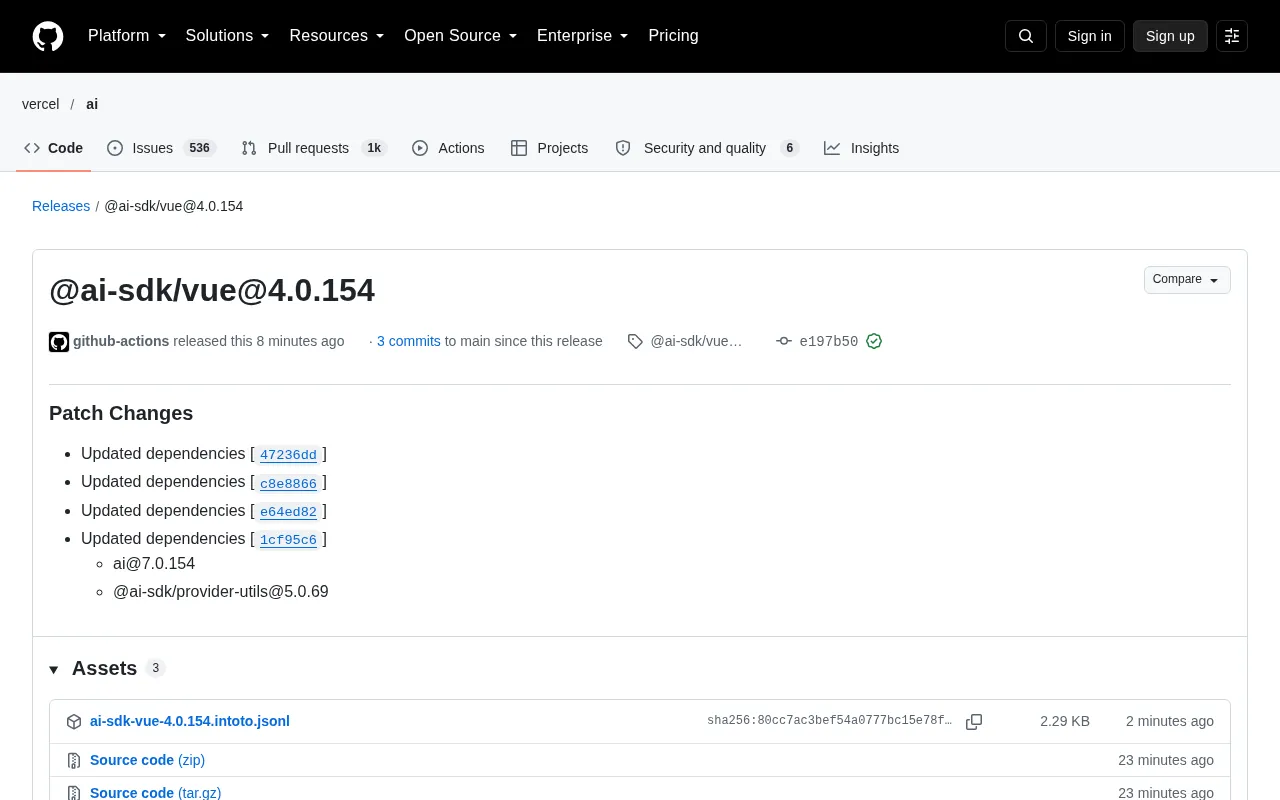
@ai-sdk/vue 4.0.154 Patch Released: Dependency Sync Upgrade
@ai-sdk/vue 4.0.154 patch released, syncing ai@7.0.154 and @ai-sdk/provider-utils@5.0.69 dependencies with no breaking changes — a low-cost upgrade for Vue AI apps.

@ai-sdk/workflow 2.0.86 Release Analysis
Analyzing the @ai-sdk/workflow 2.0.86 release: synchronized upgrades to ai 7.0.154 and provider-utils 5.0.69, and the significance of dependency linkage, automated releases, and signature verification for AI workflow development.

AI SDK Vue 2.0.282 Patch Released: Synced with ai@5.0.282
The AI SDK's Vue package releases patch version 2.0.282, synced with the ai@5.0.282 core package. This article explains the practical impact for Vue developers, upgrade advice, and the AI SDK's version iteration cadence.

AI SDK Workflow Harness 1.0.165 Patch Release
AI SDK workflow harness @ai-sdk/workflow-harness releases patch 1.0.165, auto-built and signed by github-actions, synced with @ai-sdk/harness. This article explains what a patch version means, the automated release process, and upgrade advice for developers.

@ai-sdk/zai 3.0.41 Patch Release: Synchronized Dependency Upgrades
@ai-sdk/zai releases patch 3.0.41, synchronizing provider-utils and openai-compatible dependencies. We analyze the real-world impact, upgrade considerations, and the AI SDK maintenance cadence.
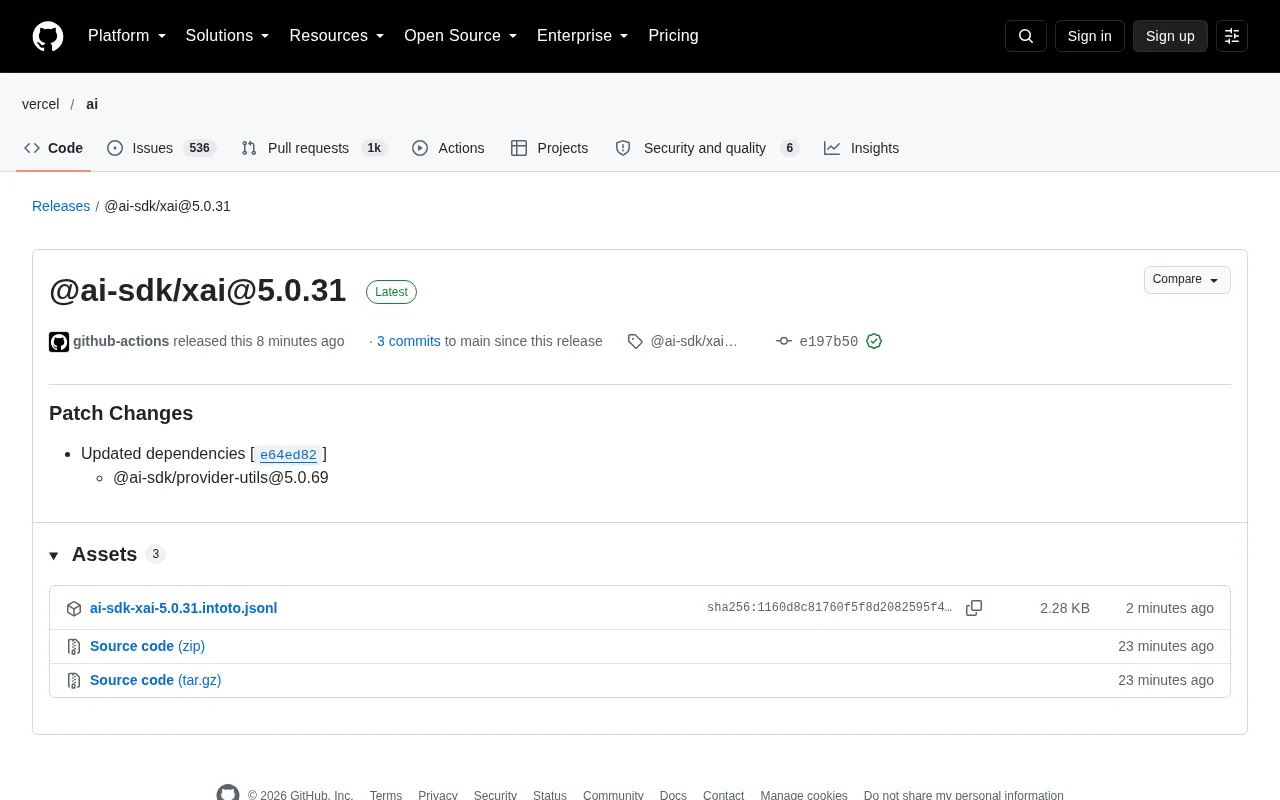
@ai-sdk/xai 5.0.31 Patch Update: A Routine Iteration of Underlying Dependencies
@ai-sdk/xai releases patch 5.0.31, with the only change being an update of the @ai-sdk/provider-utils dependency to 5.0.69. This article explains the practical impact of this update and the dependency consistency issues developers should note when upgrading.
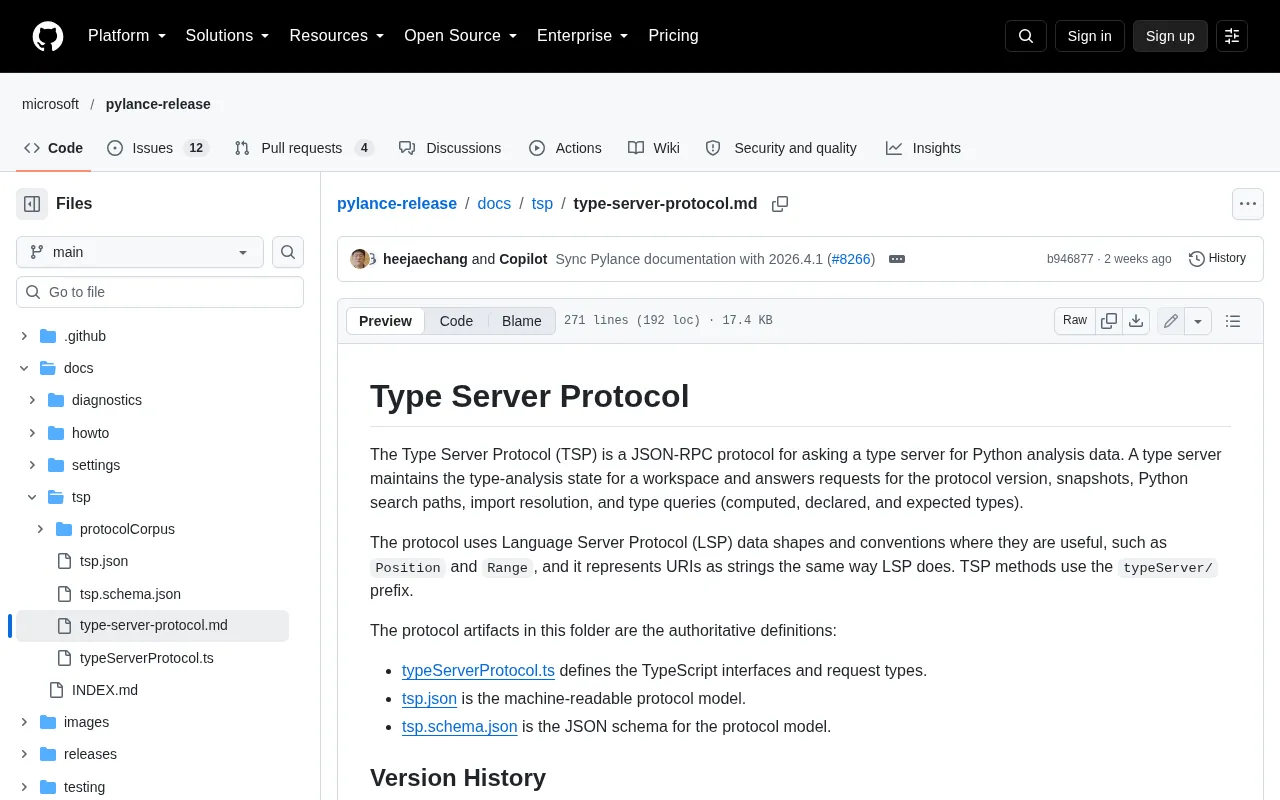
Microsoft Launches Type Server Protocol, Evolving the LSP Ecosystem Further
Microsoft releases the Type Server Protocol as an LSP extension for type system standardization. This article analyzes its positioning, decoupling significance, and adoption watchpoints.
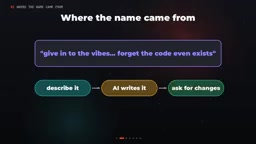
What Is Vibe Coding? Build Apps with AI and Zero Code
Vibe Coding is a new programming approach coined by OpenAI co-founder Karpathy: describe what you want in natural language and AI writes the code—no coding needed to build apps fast. This article explains how it works, its Collins Word of the Year background, the 45% security vulnerability risk revealed by VeraCode research, and tips for getting started safely.

The Most Systematic Agent Development Course on Bilibili: From Zero to Enterprise-Level Practice
An in-depth look at a systematic Agent development course on Bilibili: prompts, tool calling, memory and context management, knowledge bases, and multi-agent collaboration, with practical projects aligned to enterprise hiring.