#context window
477 related articles
 Expert Opinions
·2 min
People Who Don't Use AI to Write Code Are Becoming the 'Odd Ones Out'
AI-assisted programming has shifted from novelty to default. Over 70% of developers use AI coding tools daily. This article explores survival rules for developers in the new AI programming era.
Read more →
Tutorials
Gemini CLI Practical Guide: Custom Com…
·2 min
Gemini CLI Practical Guide: Custom Commands & MCP Plugin Configuration Explained
Complete guide to Gemini CLI setup, custom TOML commands, and MCP plugin integration. Covers free tier details, command templates, and multi-MCP Server configuration for an efficient AI coding workflow.
Read more →
Tutorials
PyCharm AI Assistant Deep Dive: Local …
·2 min
PyCharm AI Assistant Deep Dive: Local Completion, Edit Mode & Practical Tips
Explore PyCharm AI Assistant's new features: free local AI completion, cloud-powered generation, Chat & Edit modes, and context management tips for Python developers.
Read more →
Product Reviews
Context Mode: How One MCP Plugin Cured…
·3 min
Context Mode: How One MCP Plugin Cured AI Coding Assistants' Amnesia
Context Mode solves AI coding assistants' context amnesia via sandbox isolation, session continuity tracking, and code-thinking philosophy—compressing context consumption by 99% and earning 9,700 Stars in two months.
Read more →
 Tutorials
·3 min
Complete Cursor Beginner's Guide: From Installation & Setup to Efficient AI-Powered Programming
Complete Cursor beginner's guide covering installation, model selection, three conversation modes, billing rules, Rules setup, and practical AI programming tips to help you master Cursor quickly.
Read more →
Tutorials
6 Must-Have MCP Plugins to Supercharge…
·3 min
6 Must-Have MCP Plugins to Supercharge Your Claude Code Productivity
6 must-have Claude Code MCP plugins: File System, Structured Thinking, GitHub, Chrome DevTools, Context7, and Memos—build a complete AI programming workflow.
Read more →
 Tutorials
·2 min
Cursor AI Programming in Practice: A Complete Guide to Using Coding Agents Efficiently
A deep dive into Cursor's coding agent architecture and practical techniques, covering code search, feature development, debugging, code review, and custom configuration for efficient AI programming.
Read more →
 Product Reviews
·3 min
Deep Dive into the Codex Chrome Extension: How an AI Coding Assistant Breaks Beyond the Code Editor
OpenAI launches a Codex Chrome extension enabling automated actions on authenticated websites. Deep analysis of its capabilities, security design, CLI improvements, and plugin ecosystem evolution.
Read more →
 Tutorials
·2 min
Claude Code Multi-Agent Collaboration in Practice: Subagent Division of Labor and a Lite TARS Concept
Explore Claude Code multi-Agent collaboration with Planner+Packager Subagents for semi-automated project iteration, plus a lite TARS orchestration concept revealing Agent inter-calling limits.
Read more →
 Tutorials
·3 min
Figma + Cursor + UniApp in Practice: Building a Complete APP with Zero Manual Coding
How to build a complete online learning platform with Figma design, Cursor AI coding, and UniApp+UniCloud — including user APP and admin system — without writing any code manually.
Read more →
 Product Reviews
·2 min
How to Choose an AI Coding Plan? Comparing Cursor, ChatGPT, GLM, and Other Top Options
Compare top AI coding plans including Cursor Max, ChatGPT Pro, GLM Coding Plan, and DeepSeek API — with pricing, performance, and use-case recommendations to help you choose.
Read more →
 Product Reviews
·3 min
Cursor 3.0 Deep Dive: Rust Rewrite, In-House Model & Agent Orchestration Platform Fully Explained
Deep analysis of Cursor 3.0's three core upgrades: Rust rewrite leaving VS Code behind, in-house Composer 2 model with 86% cost reduction, and Agent Windows for multi-agent parallel development.
Read more →
 Product Reviews
·3 min
In-Depth Comparison of 8 AI Coding Tools: How to Choose Between Cursor, Claude Code, and Augment Code
In-depth comparison of 8 AI coding tools including Cursor, Claude Code, Augment Code, Trae, and Windsurf across model support, pricing, code quality, and context understanding to help developers choose the right tool.
Read more →
 Product Reviews
·2 min
Cursor 3.0 Update Analysis: Multi-Agent Windows and Design Mode Hands-On Experience
Deep analysis of Cursor 3.0's two core updates: Agent Window for multi-Agent parallel development with cloud cross-device collaboration, and Design Mode for direct UI modification in the browser.
Read more →
 Tutorials
·3 min
Building a Financial Report Analysis AI Agent with Cursor + Skills: A Step-by-Step Tutorial from Scratch
A hands-on tutorial for building a financial report analysis AI Agent from scratch using Cursor editor, Skills definitions, and MiniMax M2.1. Covers setup, architecture, Skills methodology, and multi-language programming.
Read more →
 Research
·3 min
110K PRs Tested: Which of 5 AI Coding Agents Is Most Reliable?
Empirical study of 110K open-source PRs comparing 5 AI coding agents (GitHub Copilot, Claude Code, Devin) on merge rates, code survival, and long-term maintainability—revealing AI code's 50% one-year survival rate.
Read more →
 Product Reviews
·3 min
Pair AI Integrates 6 Major Tools to Build an AI Coding Super Editor
Pair AI natively integrates 6 AI coding tools—Roo Code, SuperMaven, Perplexity, Memo, Continue—into one editor starting at $15/month, competing with Cursor and Windsurf.
Read more →
 Product Reviews
·3 min
AI Coding Tools Deep Dive: How to Choose Between Qoder, Cursor, Windsurf, and Devin
Deep comparison of Qoder, Cursor, Windsurf, and Devin across autonomy, reliability, and context capabilities to help developers choose the right AI coding assistant.
Read more →
 Product Reviews
·2 min
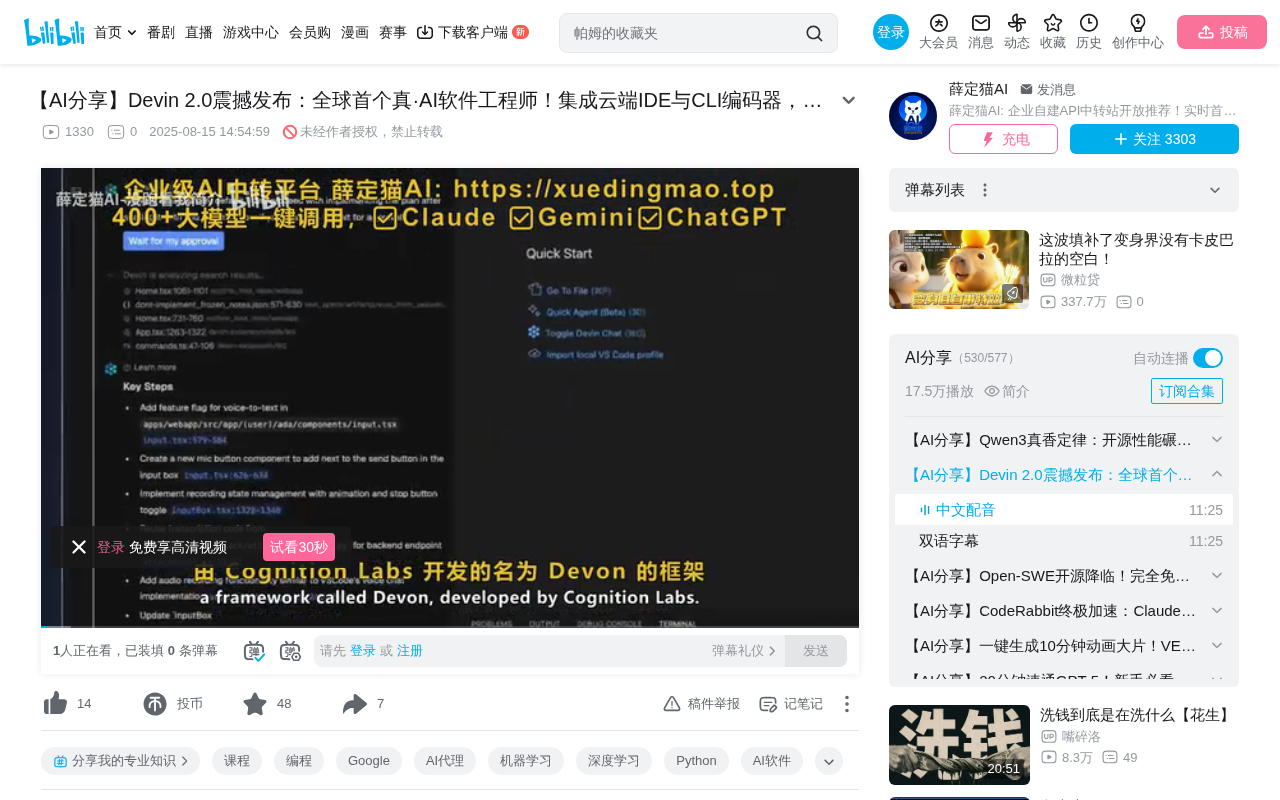
Devin 2.0 Deep Dive: What Can the First AI Software Engineer Actually Do?
Deep dive into Devin 2.0 — the latest evolution of the world's first AI software engineer. Exploring autonomous coding, multi-agent parallelism, Ask Devin, Deep Wiki, and how it differs from Copilot and Cursor.
Read more →
 Deep Dives
·3 min
Single-Agent vs Multi-Agent: A Three-Step Decision Framework for Choosing the Right Architecture
Based on Anthropic's engineering practices, a detailed three-step decision framework for single-agent vs multi-agent architecture: bottleneck identification, technical feasibility, and business value filtering.
Read more →