#token consumption
186 related articles
Tutorials
Bolt DIY + Claude 3.7: Complete Guide …
·3 min
Bolt DIY + Claude 3.7: Complete Guide to Building a Zero-Cost AI Coding Environment
Learn how to build a local AI coding environment with open-source Bolt DIY and Claude 3.7 Sonnet API. Build complete apps for just 11 cents, with free model alternatives and full deployment workflow.
Read more →
Product Reviews
Claude Code 2.0 Complete Breakdown: Ch…
·3 min
Claude Code 2.0 Complete Breakdown: Checkpoint Rollback, Context Visualization, and Other Core Features Explained
Deep dive into Claude Code 2.0's core features: checkpoint rollback, context window visualization, usage tracking, native VS Code extension, and MCP server integration, with comparisons to Cursor and Codex.
Read more →
Deep Dives
memU Memory Framework Explained: Unify…
·3 min
memU Memory Framework Explained: Unifying Multi-Modal Agent Memory with a File System
Deep dive into the memU open-source memory framework: how it organizes Agent memory as a file system with three-layer semantic abstraction, dual-loop collaboration, and two retrieval modes.
Read more →
Tutorials
AI Programming in Practice: A Complete…
·3 min
AI Programming in Practice: A Complete Breakdown of Building a Website from Scratch in 7 Days
A developer used Claude Code and DeepSeek to build and deploy a complete website from scratch in 7 days. 99% AI-written code, AI-generated data, with full process breakdown and cost analysis.
Read more →
Tutorials
UE5 + AI in Practice: Using MCP to Bri…
·2 min
UE5 + AI in Practice: Using MCP to Bridge Blueprint and C++ Development Workflows
Hands-on guide: Using AI tool OpenCode with Unreal Engine MCP to automate C++ coding and Blueprint operations, with workflow best practices and lessons learned.
Read more →
Tutorials
The Complete Guide to Spring AI: A Ful…
·3 min
The Complete Guide to Spring AI: A Full Learning Path for Java Engineers Building AI Applications
A comprehensive guide to Spring AI covering LLM integration, prompt engineering, RAG knowledge bases, and five AI Agent patterns, with three enterprise projects for Java engineers.
Read more →
Deep Dives
Hermes Self-Evolution Framework: An Op…
·3 min
Hermes Self-Evolution Framework: An Open-Source Solution for Automated AI Agent Prompt Optimization
Deep dive into NousResearch's open-source Hermes Agent self-evolution framework, using DSPy and GEPA for automated prompt optimization with five-layer safety mechanisms.
Read more →
Tech Frontiers
Generic Agent: A Self-Evolving AI Agen…
·3 min
Generic Agent: A Self-Evolving AI Agent Built with Just 3,000 Lines of Code
Generic Agent builds a self-evolving AI agent with just 3,000 lines of code, 9 atomic tools, and a five-layer memory architecture — using only one-sixth the tokens of competitors.
Read more →
Tutorials
Claude Code: 19 Essential Commands Exp…
·3 min
Claude Code: 19 Essential Commands Explained with Practical Tips to Avoid Common Pitfalls
A deep dive into 19 essential Claude Code commands across conversation management, settings, utilities, permissions, and plugins, plus a golden workflow to double your dev productivity.
Read more →
Tutorials
Codex Team Reveals a New AI Programmin…
·4 min
Codex Team Reveals a New AI Programming Paradigm: Organizational Skills Replace Coding Skills
OpenAI's Codex team shows AI programming now prioritizes organizational skills over coding. Learn the four paradigm shift signals, efficient workflows, and how developer roles are being reshaped.
Read more →
Tutorials
Multi-Model AI Development in Practice…
·2 min
Multi-Model AI Development in Practice: A Guide to Unified API Gateway Architecture Design
Learn how to overcome single-model AI limitations by designing a unified API gateway architecture for multi-model collaboration, covering task routing, failover, and cost optimization strategies.
Read more →
Product Reviews
GPT 5.5 vs Claude Code vs DeepSeek V4:…
·3 min
GPT 5.5 vs Claude Code vs DeepSeek V4: Hands-On Comparison of Three Top Coding Models
Hands-on comparison of GPT 5.5, Opus 4.7 (Claude Code), and DeepSeek V4 Pro through a 3D flight simulator and WebGPU shader test — covering coding ability, pricing, and real-world performance.
Read more →
 Product Reviews
·2 min
feishu-claude-bridge Open Source Project Analysis: A Practical Guide to Integrating Claude Code with Feishu
In-depth analysis of the feishu-claude-bridge open-source project: how to use Claude Code for AI programming directly in Feishu, covering architecture, deployment, and use cases.
Read more →
 Tutorials
·3 min
Complete Cursor Beginner's Guide: From Installation & Setup to Efficient AI-Powered Programming
Complete Cursor beginner's guide covering installation, model selection, three conversation modes, billing rules, Rules setup, and practical AI programming tips to help you master Cursor quickly.
Read more →
 Product Reviews
·3 min
Cursor 3.0 Deep Dive: Rust Rewrite, In-House Model & Agent Orchestration Platform Fully Explained
Deep analysis of Cursor 3.0's three core upgrades: Rust rewrite leaving VS Code behind, in-house Composer 2 model with 86% cost reduction, and Agent Windows for multi-agent parallel development.
Read more →
 Product Reviews
·3 min
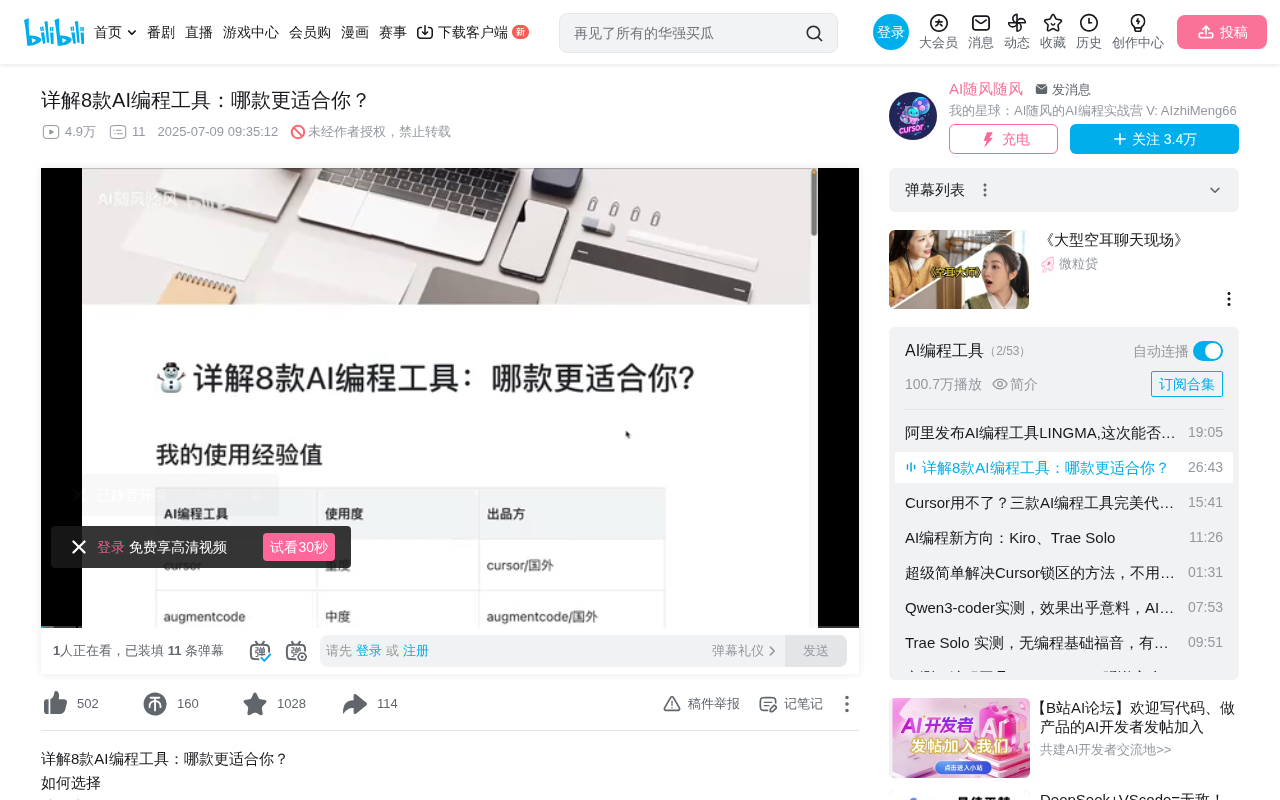
In-Depth Comparison of 8 AI Coding Tools: How to Choose Between Cursor, Claude Code, and Augment Code
In-depth comparison of 8 AI coding tools including Cursor, Claude Code, Augment Code, Trae, and Windsurf across model support, pricing, code quality, and context understanding to help developers choose the right tool.
Read more →
 Tutorials
·3 min
Hermes Agent + Playwright: A Practical Guide to AI-Driven Browser Automation
A complete guide to AI-driven browser automation with Hermes Agent and Playwright, covering setup, three AI modes (snapshot decisions, multi-turn dialogue, autonomous exploration), retry mechanisms, and optimization tips.
Read more →
 Deep Dives
·3 min
Single-Agent vs Multi-Agent: A Three-Step Decision Framework for Choosing the Right Architecture
Based on Anthropic's engineering practices, a detailed three-step decision framework for single-agent vs multi-agent architecture: bottleneck identification, technical feasibility, and business value filtering.
Read more →
 Deep Dives
·2 min
Hermes Agent Deep Dive: An Open-Source AI Digital Worker That Learns
Deep dive into NousResearch's open-source Hermes Agent framework: memory systems, skill reuse, tool calling, security, deployment guide, and multi-agent collaboration.
Read more →
 Deep Dives
·2 min
AI Agent Development Methodology: A Complete Guide from ReAct to Enterprise-Grade Tech Stack
A deep dive into AI Agent development methodology, from the ReAct theoretical framework to a four-layer enterprise tech stack covering model services, Agent types, LangChain, and production deployment.
Read more →